



“Actually, that’s where the gold is,” said Alasdair Russell, my graduate school friend who leads a pre-clinical genome editing group at Cambridge.
He was talking about the winding road of science that is omitted from published papers. “When you’re discussing how to do the experiment, and why this way is better than another way, and what does the data really mean? I know what it shows, but what does it mean?”
At RAAIS 2026, he described how his group has begun logging the twisting path of discovery as it happens, recording the verbal and written exchanges that normally disappear. Ideas become nodes in a living graph: they branch when a meeting produces two plausible experiments, merge when separate lines of evidence converge, and go dark when someone quietly stops pursuing them. In his implementation, one agent scores novelty, while another tries to learn “how scientists think and how they navigate through a complex world of data,” so that high-potential nodes can trigger deeper investigation.
As frontier AI labs deploy agents toward scientific discovery, giving AI authentic scientific taste remains a trillion-dollar dilemma. The bottleneck is that the record we have kept for centuries of science might be insufficient to get us there.
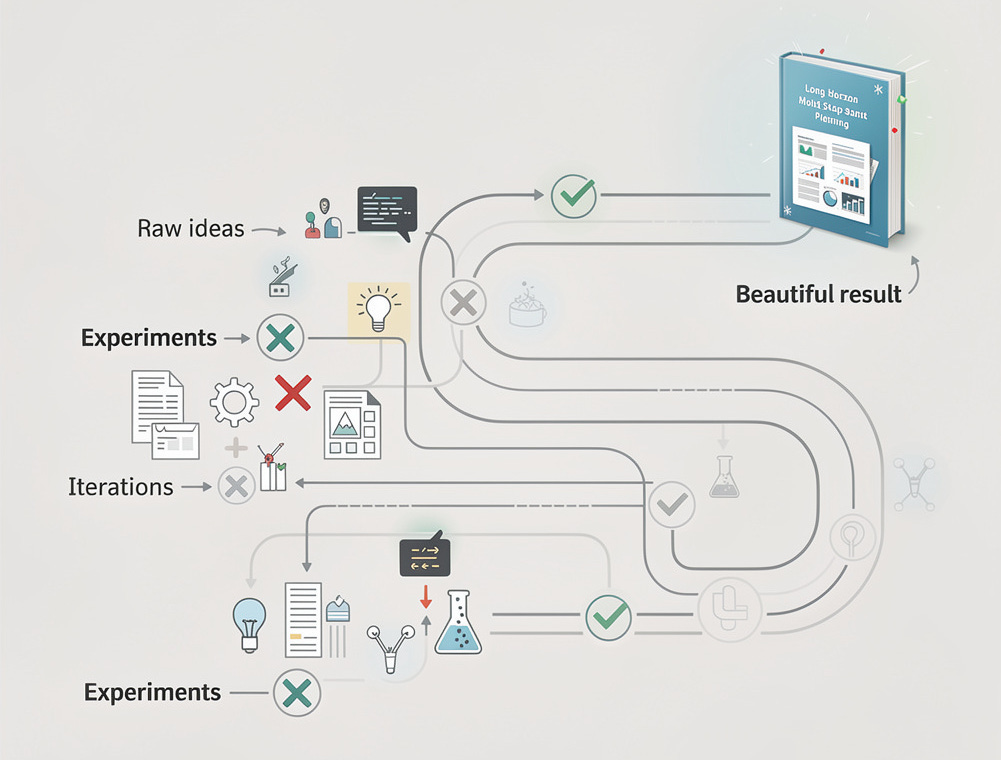
The experiments that never make the paper
Peter Medawar, 1960 Nobel laureate and “father of transplantation,” asked in 1963 whether the scientific paper was a fraud, and answered yes: the form of the paper misrepresents the thinking that produced it. Sixty years on, the diagnosis is unchanged. A paper presents a clean progression from hypothesis to result to conclusion. Lost along the way are the unconventional theories, the abandoned or unaffordable methods, and the underwhelming and inconclusive data.
It reads like a browser history with every dead end deleted: the ten open tabs, the four rephrased queries, the wrong turn down a subforum. All scrubbed, leaving one clean path from question to answer as the canonical path.
What has changed since then is that the discarded material is now worth something. No high-impact journal wants these artifacts, but raw trial and error is the most likely source of the training data required to develop scientific intuition, or what researchers call taste.
Earlier attempts to capture the discards were motivated by scientific integrity. The Journal of Negative Results in Biomedicine launched in 2002 to publish rigorous studies that disputed established models or exposed ineffective treatments. Its archive preserved negative conclusions after they had become papers, rather than the live alternatives and arguments that produced them. BioMed Central closed it in 2017, saying the mission had been served now that other journals publish null results. A less generous reading is that in fifteen years it published around 200 papers because almost nobody wants to read a negative result, let alone write one up when it will not count toward academic tenure.
AI models are different. Even an uninteresting negative result can be useful, provided it is labeled.
Earlier this year, Anthropic put a version of this to the test. The company pulled 129 decision points from real Claude Code sessions between January and March 2026, showed models the work up to a human detour, and asked what should happen next. Claude Mythos Preview beat the human choice 64% of the time, while Opus 4.5 managed 51%. The comparison was tilted toward the models because Anthropic deliberately chose moments where the human decision had room for improvement. On 127 further scenarios where the human action was already strong, the models improved on it only about 20% of the time.
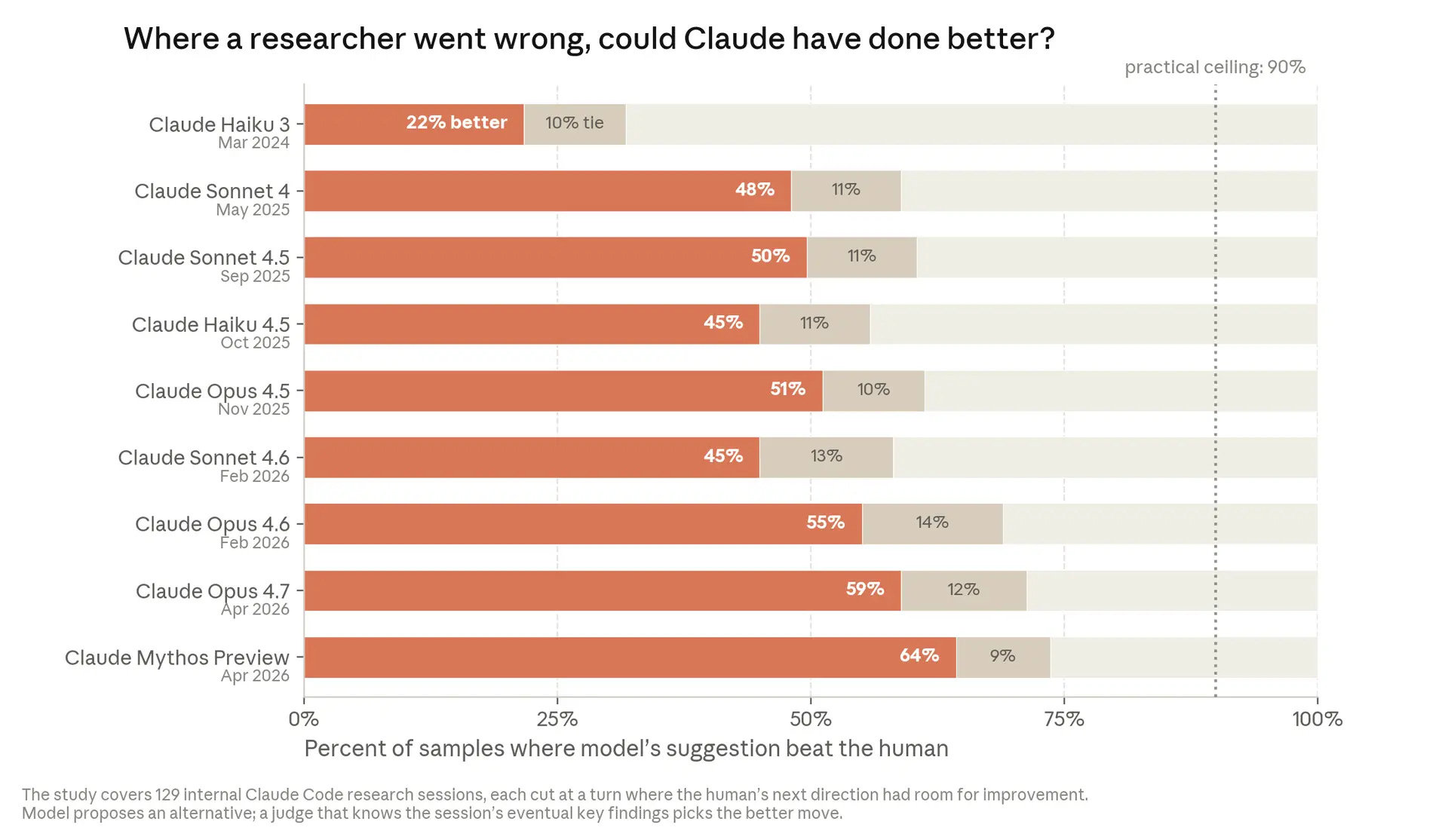
The study was possible because Anthropic’s researchers work inside a tool that logs by default. The reasoning, detours and outcome are produced in the same working environment. Biology has no equivalent. Its reasoning happens in hallways, at benches, in Slack threads and on whiteboards, while the outcome arrives weeks later somewhere else. The record has to emerge from the work itself. Ask scientists to reconstruct it afterwards and we’ll create another polished account.
A log is not a label
Before any of this becomes training data, a negative result has to say what failed. The first paper published in the Journal of Negative Results in Biomedicine examined 234 negative studies across five leading medical journals. Only 30% discussed statistical power, and half clearly defined a primary outcome. Tell a model an experiment failed, without telling it whether the assay was underpowered, a reagent had degraded, or the hypothesis was simply wrong, and it will learn noise with confidence.
Decision histories have a second missing label too. When a lab considers five experiments and runs one, only the chosen branch returns an outcome. The other four are experimental counterfactuals. Researchers call this the selective labels problem: the data reveal results only for the actions someone chose to take. Such a record can teach a model to imitate a lab’s taste, but it cannot establish that the taste was good. It also smuggles local constraints into general lessons. A lab that never ran cryo-EM because it did not own a microscope teaches a model that cryo-EM is rarely the right call.
Alasdair’s nodes preserve the candidate set, which is the necessary first step. To be useful, each decision record needs six fields:
The evidence available at that moment, and nothing that arrived later.
The candidates considered, including the ones dismissed in a sentence.
For each candidate: the expected result, the confidence attached to it, and the cost in time and money.
The route chosen, and the reason.
What happened next.
How the evidence changed the scientist’s view.
These must be timestamped before the outcome, because hindsight turns uncertainty into inevitability. Disagreement also has to survive. Averaging three scientists into one clean rationale reproduces exactly the information loss we are trying to fix.
But there is an obvious failure mode here. Once decisions are logged and scored, people log for the record post-facto. Anyone who has watched an electronic lab notebook fill up with retrospective tidying knows how quickly a research tool becomes a compliance exercise. A record that costs a scientist ten minutes of honest reflection per decision is worth far more than one that costs an hour of performance.
A publication initiative called Registered Reports offers a useful starting point. Here, researchers submit their rationale, methods and analysis plan for peer review before the data exist, and the journal commits in principle to publish if they follow the approved plan. Nature has now expanded the format across every field it covers. This approach to paper writing timestamps intent before the outcome, but it freezes one plan. A useful search history must also preserve how the plan changed, which alternatives were rejected, when, and on what evidence.
Run the runner-up
Autonomous labs show what happens when decisions and outcomes are connected in a loop. Liverpool’s mobile robotic chemist ran 688 experiments over eight days in a ten-variable formulation space. A batched Bayesian search used each result to choose the next experiments and found photocatalyst mixtures six times more active than the starting formulations. Every completed experiment changed what the system did next.
The robot optimized within a goal and search space that humans had already chosen. It did not decide which scientific question mattered. So what this work demonstrates is narrower, but still useful: a search history pays off when the options return standardized outcomes quickly. Open-ended biology is harder because branches can take weeks and the discarded alternatives may never be run.
Some exploration therefore has to be bought. Where two branches are plausible and the stakes justify the cost, a lab should sometimes run the runner-up. Otherwise the record captures what today’s scientists usually chose and stays silent on what they systematically overlooked. A funder could ring-fence a small fraction of a grant for the branch not taken, provided that the decision record and the outcome are both deposited. That costs money, but so does having every lab rediscover the same abandoned path.
Test whether taste transfers
When it comes time to evaluate if our new AI system exhibits taste, the comparison should run across laboratories and fields. At selected decision points in a live research campaign, we should freeze the six fields: the evidence, the candidates, expected results, confidence, costs and the choice made. Experts then rank the options before the outcomes are known, and those outcomes are checked independently later.
We could give models one of two diets - papers alone, or papers plus decision histories - and ask them to rank the next experiment on unfamiliar projects. Then, we score information gained per dollar and week, calibration, and how quickly weak branches are abandoned.
If histories improve choices only inside the lab that produced them, they amount to useful organizational memory. If they improve choices on unfamiliar problems elsewhere, Alasdair’s group will have captured something science has never managed to write down: a transferable record of taste. Until that happens, a scientific search history is a promising record, not yet a training set.
This is the organisational-memory problem in another coat. Giving a system the published document estate is not the same as giving it the branches people considered and dropped. In the businesses I work in, that discarded path is usually the useful context, and it has never been written down. Your six fields are a test I would run on a real company: can they timestamp a decision before the outcome, or do they only tidy the log afterwards?
Alasdair's six fields are a genuinely useful proposal, and the diagnosis — that published papers scrub away exactly the reasoning that would teach a model taste — is right. But I think the deeper problem here isn't measurement bias or the selective-labels issue (both real, both well described). It's older, and it already has a name.
In 1932, the Vienna Circle had almost this exact argument, about almost this exact object. Otto Neurath attacked the idea that science could be grounded in "protocol sentences" — theory-neutral observation reports recording what actually happened in the lab, prior to any interpretive gloss. His point: a protocol sentence is still a sentence. Deciding what counts as "the evidence," what counts as a "candidate," where the confidence threshold sits — all of that is already interpretation, wearing the costume of a raw record.
I don't think this sinks the six-field proposal — it just relocates the problem instead of solving it. A perfect decision log doesn't give a model unmediated access to Alasdair's reasoning; it gives the model a second, more granular text about that reasoning, produced by someone deciding in real time what belongs in each of the six boxes. That's still an improvement on a paper's retrospective narrative — Neurath thought protocol sentences were useful, just not foundational — but it isn't the escape from theory-ladenness the piece seems to promise.
Genuine question: does "taste" require something closer to raw causal contact with the lab — Alasdair's living graph, video, sensor logs, the works — rather than any verbalized protocol, six fields or sixty? Or is verbalized, theory-laden judgment actually the only kind of "taste" worth training for, since it's the only kind a scientist can act on either?