


Today, I’m excited to announce Perceptic, the AI operating system for biopharma, as it comes out of stealth with a $12M seed round from Air Street Capital, Accel and angels. Built by the team behind Palantir’s AIP and Life Sciences practice, Perceptic is already used by multiple top-20 pharma companies including CSL to discover new drug assets, expand indications, test novel hypotheses and analyze clinical data.
In this piece, I’ll share why a system that connects research, development and clinical decision-making across the full lifecycle of a drug is critical, and why Perceptic is the company to do it.
Can AI accelerate drug discovery?
Drug discovery is expensive, slow and low-hit-rate. We all know this. What is new is that we now live in an era of AI systems that can consume and reason over the multi-modal evidence drug development actually generates - targets, chemistry, biology, clinical, commercial - and across the sprawl of databases, dashboards, notebooks, departments and geographies it lives in.
Look at where the frontier labs are putting their attention. Anthropic recently added Vas Narasimhan, the CEO of Novartis, to its board, and is openly building Claude into a partner for scientific work. OpenAI’s reasoning model just disproved an 80-year-old Erdős conjecture in discrete geometry, verified by external mathematicians on a problem the field had not cracked since 1946. Science - and biology especially - is the pinnacle AI use case, and the labs are not being subtle about wanting it.
A few months ago I wrote Can AI discover new science?, arguing that AI is now an accelerator of discovery, not just an automator of existing work. But drug development is one of the highest-stakes environments that does not come with clean verifiers: no leaderboard, no public benchmark, no “the model proved the lemma” moment. The contributions only count when they are wired into the workflows where billion-dollar, multi-year decisions get made, with every conclusion traceable back to the evidence that produced it. The labs have given us the substrate: frontier models. Pharma now needs the operating system, and this is where Perceptic comes into play.
The Perceptic operating system
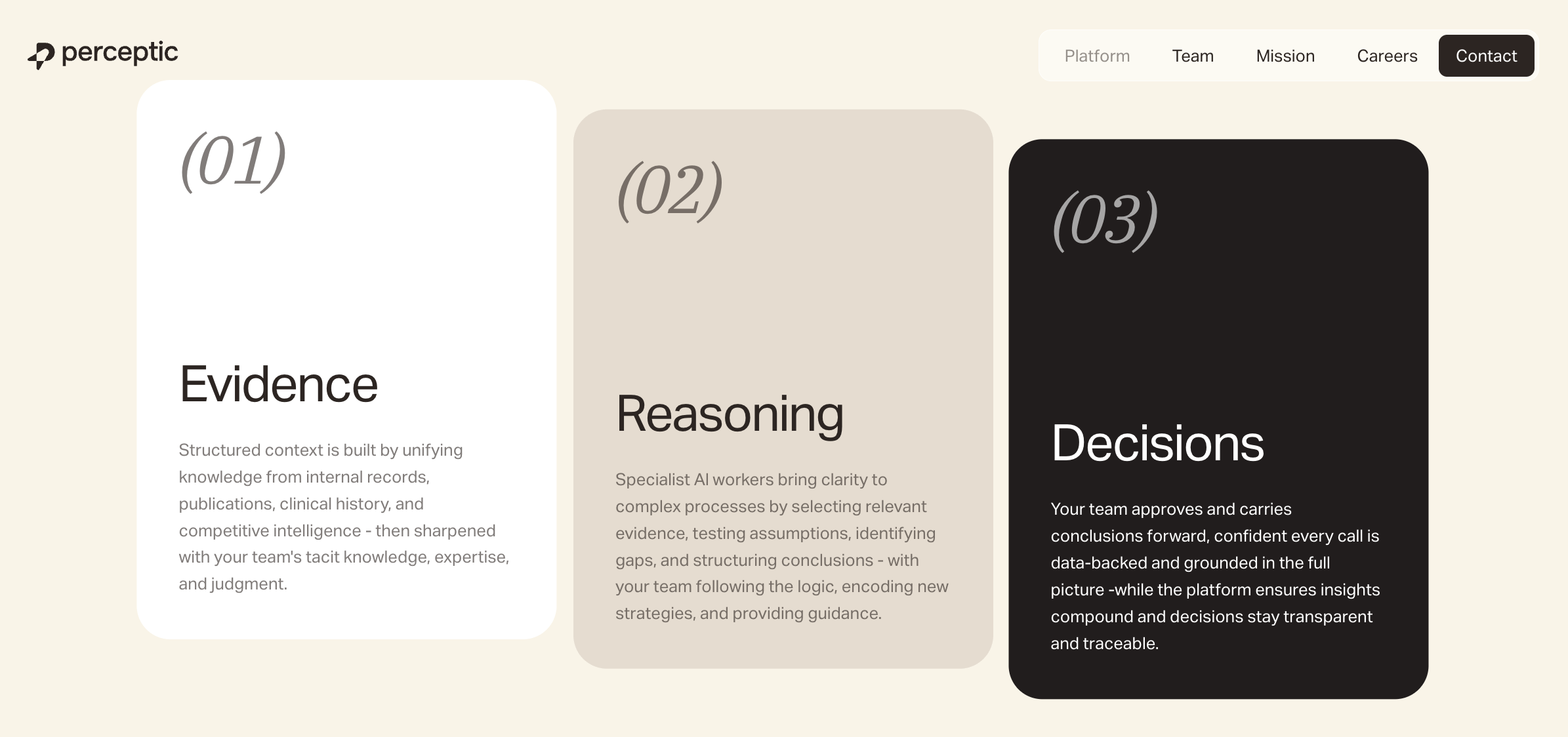
Perceptic is the intelligence layer that connects data, decisions and context across the drug lifecycle, so every insight compounds and every decision is made with the full picture. Three AI applications run on one shared architecture:
Scout triages external assets, including licensing candidates, competitive programs, pipelines, against the customer’s evolving strategy. Evaluation time has gone from a week to an hour in production while asset screening from hundreds per week to thousands in minutes.
PercepticOS is the intelligence layer above the customer’s internal tools and data. It is where scientific teams test hypotheses, compare internal evidence against external benchmarks, and build a knowledge base that doesn’t restart with every new project.
Atlas is the clinical data foundation that recapitulates internal and external trial data, providing the substrate everything else stands on. Live deployments have produced a 50-fold increase in clinical data extractions.
Perceptic in practice
A pharma company evaluating a new therapeutic area starts inside PercepticOS, pressure-testing a hypothesis against the evidence base. That triggers Scout to sweep external assets and rank them against the evolving thesis, in minutes instead of weeks. Candidates feed back into PercepticOS with full context, where Atlas surfaces the trial history, benchmarks and endpoint precedents that determine which assets are tractable.
A customer doesn’t buy three products. They deploy AI workers that learn their organization, their tools, their data, their decisions, and the instance gets more valuable every month. Perceptic follows the drug, not the department.
The perfect team, forged at Palantir
Air Street Capital has invested in many AI-first techbio companies including Profluent, Allcyte (acquired by Exscientia), Valence Discovery (acquired by Recursion), all of which are in the business of discovering novel drugs. Perceptic is the opposite bet: the AI-first software that makes drug developers themselves better and faster.
As an investor I am generally of the view that the money is in the drug, not the tools. Perceptic is the exception. The moment has come to bet on the AI-first software layer, and the right team has shown up to build it.
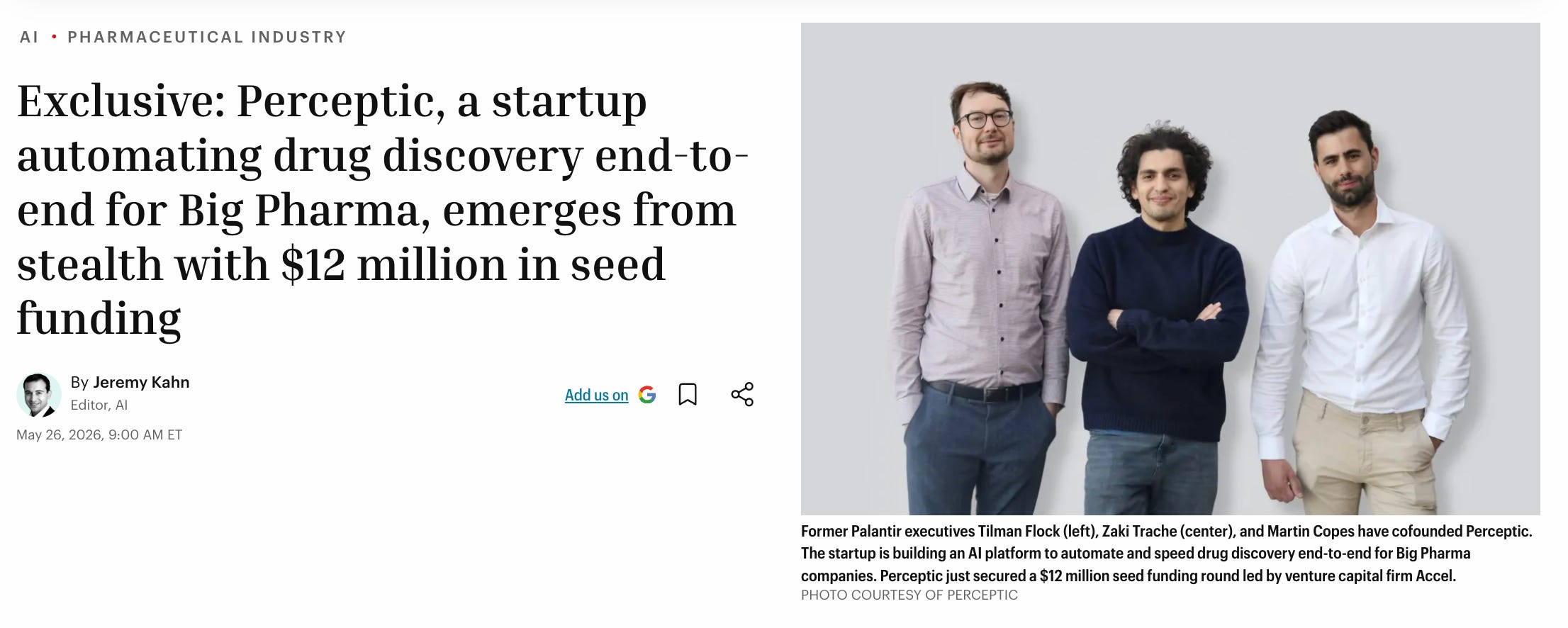
Two ingredients matter, and they are rarely found together. The first is the DNA of shipping production AI into the hardest enterprise environments. Tilman, Martin and Zaki were core contributors to Palantir’s AIP, the suite designed to securely connect frontier AI with an organization’s internal data and operations. They are operators who learned over a decade what it takes to put production AI inside regulated, data-sensitive, multi-stakeholder enterprises. They know where deployments break, and what the six-month security reviews actually ask for.
The second is deep knowledge of pharma workflows themselves. Frontier models are spiky in their capabilities, and the spikes only line up with value when you graft them onto the proprietary workflow knowledge of the end user. The team’s years inside Palantir’s Life Sciences practice mean they understand the nitty-gritty of bending increasingly capable frontier AI systems into the shape pharma R&D actually requires. That is not something you can buy on the open market.
CSL and multiple top-20 pharma companies that we cannot name publicly trusted that thesis enough to deploy Perceptic before the company came out of stealth - the highest-signal proof point any seed-stage company can have.
What comes next
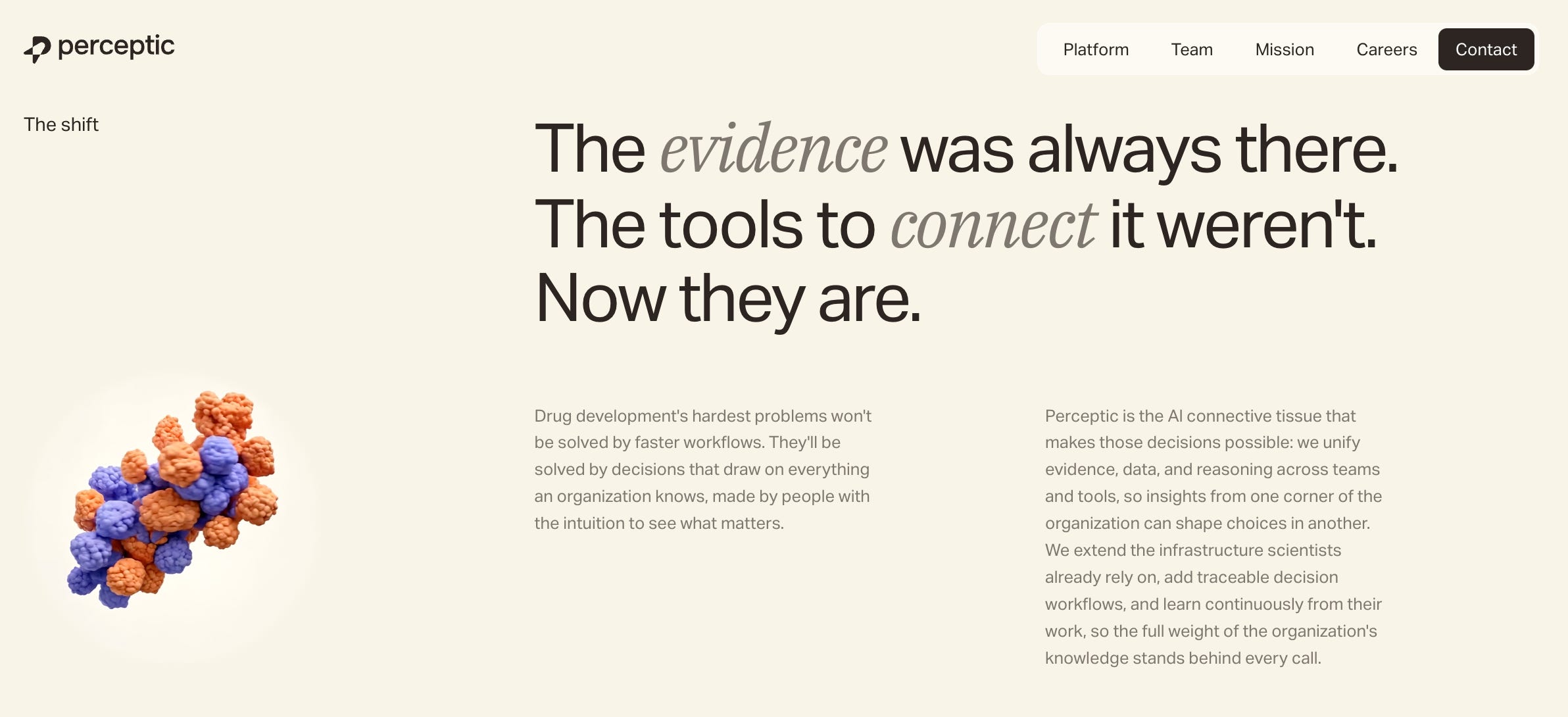
If Perceptic is right, drug development moves from a 15-year linear bench-to-bedside process to one that runs on always-on infrastructure, where every insight from every team is wired into every subsequent decision. The handoffs stop being where information dies: they become where it accelerates.
That is the category that is forming around Perceptic.
Congratulations to Tilman, Martin, Zaki and the whole Perceptic team. We’re proud to be on the journey.
- Nathan
Insightful observation. The AI landscape is evolving rapidly, but sustainable advantages will come from execution, distribution, and solving real customer problems, not just model performance.