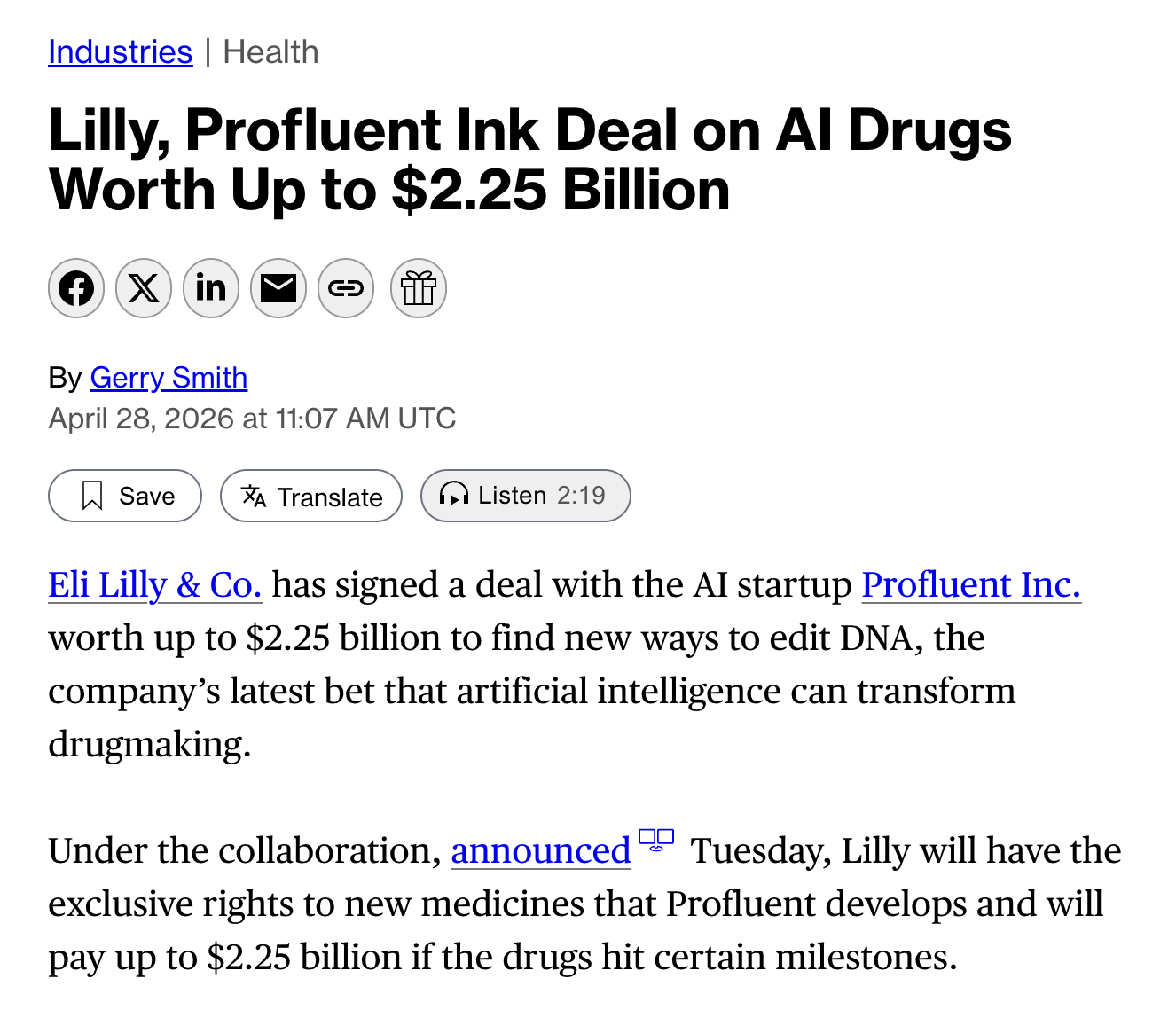
A landmark $2.25B+ partnership
This morning, Air Street Capital portfolio company Profluent announced a multi-program strategic partnership with Eli Lilly to develop AI-designed recombinases for genetic medicine. Profluent will receive an upfront payment, committed R&D funding, and is eligible for up to $2.25 billion in development and commercial milestones, plus tiered royalties on net sales.
This is the story of one of the hardest unsolved problems in genetic medicine kilobase-scale DNA editing - that finally has a credible path forward.
Kilobase-scale editing is the frontier
CRISPR was the breakthrough that taught us how to read and cut DNA at any address in the genome. It is a remarkable tool. It is also, in its dominant clinical incarnation, a typo corrector. Cas enzymes excel at breaking genes or, with engineering, making small changes to a single base or a short stretch. That solves a meaningful subset of genetic disease: the subset where one mutation, in one place, drives one phenotype.
The harder subset, and arguably the larger one, is genetic disease driven by heterogeneity: hundreds or thousands of different mutations across a patient population, scattered across the same gene. Cystic fibrosis is a textbook case. Many forms of inherited hearing loss, retinal dystrophy, and metabolic disease look the same. You cannot afford to develop a separate base-editing therapy per mutation. The economics never work.
The way through is to stop fixing typos and start replacing the whole paragraph: insert a healthy copy of the gene, in its correct genomic location, in one shot. Kilobase-scale, programmable, precise DNA insertion. This has been the holy grail of genetic medicine for as long as genetic medicine has existed.
It has also been more or less out of reach until now.
Why recombinases and why they were stuck
Long before CRISPR, biologists knew about a class of enzymes called recombinases that do exactly the kind of large-scale DNA cutting and pasting that kilobase editing requires. Recombinases are precise, they are programmable in principle, and they have been used for decades as research tools.
CRISPR’s targeting is outsourced to a guide RNA: the enzyme stays the same; you change the guide; you go anywhere in the genome. Recombinases have no such modular guide. Their specificity is built into the protein itself, encoded in the three-dimensional shape of the enzyme. Retargeting a recombinase means redesigning the protein.
For most of the past few decades, redesigning a recombinase to hit a specific human genomic site with clinical-grade specificity was either impossible or so laborious it was not worth attempting. The field tried directed evolution. The field tried hand-crafted protein engineering. The results were narrow, slow, and difficult to generalise.
This is exactly the kind of problem that gets unstuck the moment you have a frontier model for proteins.
Gene editing is now an AI problem
Profluent’s is that protein design is a frontier AI problem, not a biology problem with AI bolted on. The company trains large frontier models on the world’s largest protein dataset, including the most comprehensive curated database of naturally occurring recombinases. It then conditions those models to generate novel enzymes for targets of interest: proteins that, in many cases, do not exist in nature and that would not have been found by searching nature for them.
The 2024 work that put Profluent on the map was the first public proof point of this thesis: AI-designed Cas proteins, built from scratch, that work. The lesson was that the same approach that worked for Cas should generalise to any class of designable protein where the data and the objective function are clear.
Recombinases are a near-ideal target for that thesis. There is enormous natural diversity to learn from. The substrates and target preferences of those natural recombinases can be matched to provide rich training signal. The goal is to design a protein that cuts and pastes a long stretch of DNA at a chosen genomic address with high specificity. This is a problem whose physics, data, and objective are all well set up for generative modelling.
If Profluent are right, kilobase-scale editing transitions from a discovery problem - sift through nature, hope you get lucky - into a design problem. You name the address; the model generates the editor.
Why Lilly
The right partner for a platform play in genetic medicine is the company that is most aggressively building out the full clinical and commercial stack to take genetic medicines to patients. Lilly fits the description. Over the last few years they have stood up a dedicated genetic medicine center, acquired multiple in vivo gene and cell therapy companies, and signed a string of AI-native R&D collaborations. They are systematically assembling the components needed to industrialise genetic medicine - for rare disease today, and for a much larger set of common diseases as the toolkit matures.
A partnership of this shape, being multi-program, exclusive licensing on selected programs, $2.25B in milestones plus royalties, is what platform validation looks like.
What the future looks like
Profluent is building a programmable platform: name a genomic address, name the desired insert, get a designed editor whose properties are known in silico before anyone steps into a lab. Combine that with the in vivo delivery capabilities the field is rapidly maturing, and you have, for the first time, a credible path to therapies for diseases where the underlying genetics has always been the obstacle. These include heterogeneous monogenic disease, large-payload corrections, multi-gene insertions, and ultimately common diseases with structured genetic risk.
The next generation of gene editors will not be the ones we found in nature. They will be the ones we designed.
I am extremely proud to have been working closely with Ali and his team since day 1 of Profluent and making the company the largest position in the Air Street portfolio over the years. Today is a milestone for them and for the field - and a strong signal of where AI-designed biology is heading next. Congratulations to the entire Profluent team, and to the partners at Lilly stepping in at exactly the right moment.