



The most important thing Google DeepMind has learned in twenty years, Raia Hadsell argued at this year’s RAAIS, is that a large model trained on enough data from a complex system learns the underlying patterns of that system. Language is one such system. Weather, biology, synthetic worlds, and physical movement are others, and her frustration is that the field keeps treating language as the whole game.
Hadsell spoke at the first Research and Applied AI Summit in 2017 and returned to open the tenth. She is now VP of Research at DeepMind, where she co-leads a Frontier AI unit of roughly a thousand researchers and engineers across about a hundred projects, and she did not start in machine learning: her undergraduate degree was in philosophy. Her talk was, in part, a corrective.
The case against one token at a time
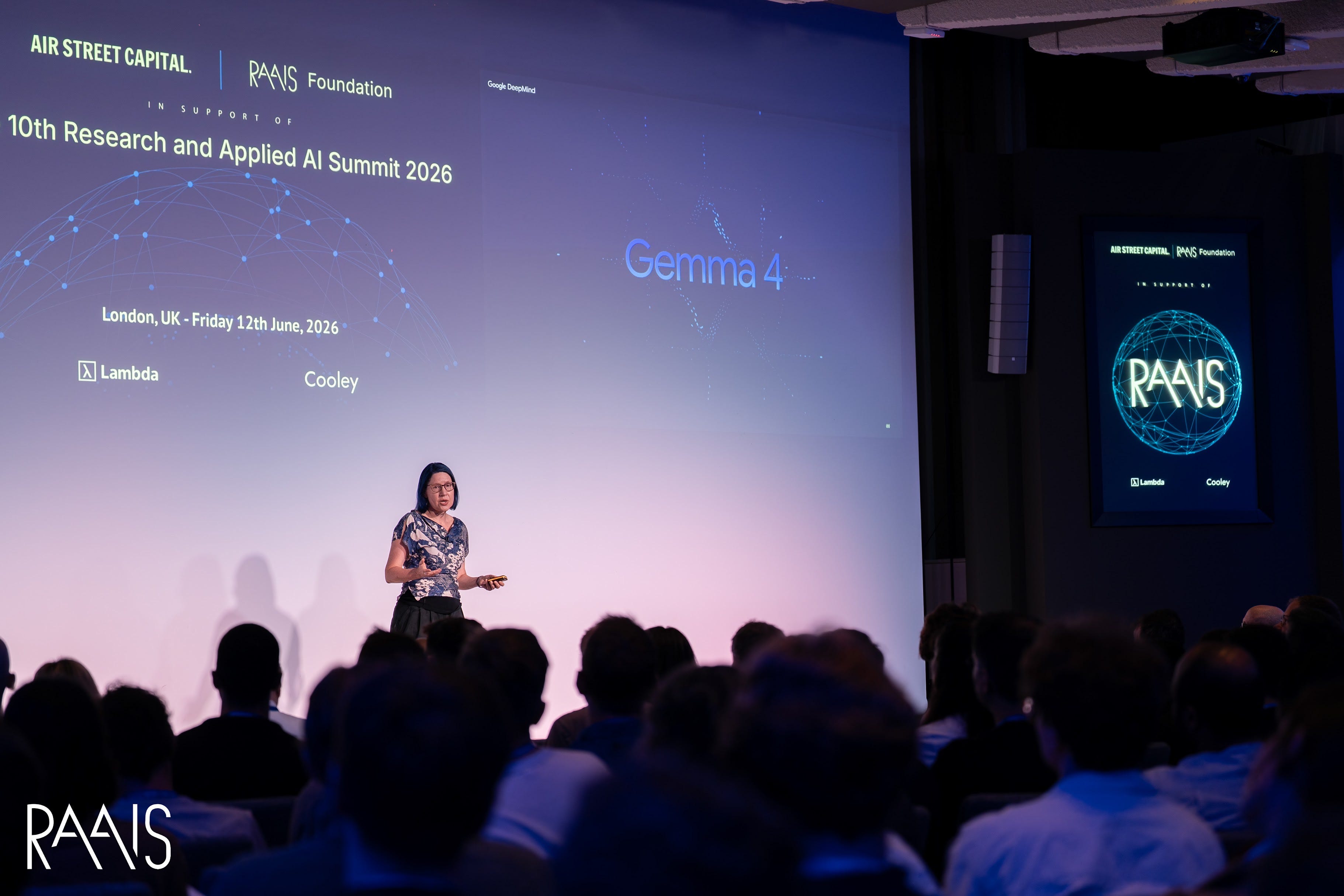
Less than 48 hours before she spoke, DeepMind released DiffusionGemma, a new open model in the Gemma 4 family, under an Apache 2.0 license. It is a 26-billion-parameter mixture-of-experts model, and it generates text in a way most language models do not. Instead of producing one token after another, it borrows the recipe behind image and video generation: take a sample, add noise, and learn to denoise it. Applied to text, that means generating a whole block at once rather than committing to each word in sequence.
The mechanism buys two things. Inference is faster, because the model is not walking left to right. And because it writes and revises a whole block, it can reason in both directions and correct itself. Hadsell showed it solving a problem while displaying its work: after the first denoising step it commits to the wrong answer, by the second it reconsiders, and by the third the whole block is consistent and right. An autoregressive model, having locked in each token as it went, cannot do that. It is the reason, she said, that a left-to-right model is structurally ill-suited to sudoku, which demands seeing the whole grid and reasoning across it at once. Diffusion also delivers adaptive computation as a side effect: easy questions converge in a couple of steps, harder ones take more. In practice it is fast enough to keep up with you in real time, writing, running, and testing code as quickly as you can describe what you want. Still, DiffusionGemma is an experimental release rather than a replacement for the standard autoregressive Gemma 4 models, and text diffusion carries trade-offs of its own. DeepMind shipped the fine-tuning code alongside the model.
Better agents need better worlds
Hadsell traced DeepMind’s world-model work back to a simple idea: you get better agents by building better environments, ones rich enough to keep generating new situations to learn from. A world model simulates the dynamics of an environment, and DeepMind sees these as central to the path to AGI because they supply unlimited, rich training worlds for agents.
The line runs from Genie-1, trained in 2023 on 2D platformer games and published in 2024, to Genie-2, which moved to latent diffusion and produced interactive 3D environments that were still synthetic and not real-time, to Genie-3, which is high-resolution, works across domains, and runs in real time for several minutes while staying consistent. You feed it a text prompt and get back a world you can move through. Prompt “a country lane in Kent, England,” add rain, and the model fills in the person walking, the puddles, and a pair of yellow boots she is fairly sure she does not own. You can change the world mid-stream by typing a new prompt into it.
Last month the team grounded Genie in Street View. They take one of Street View’s static panoramas, turn it into a short video, prompt in changes such as winter weather or a character, and feed that in as the opening frames of a Genie world, enough to walk across the Golden Gate Bridge and then dive underwater while the model keeps the bridge’s geometry intact. Hadsell is most excited about education: being present at a historical event instead of reading about it, or following a red blood cell through the circulatory system, with the model tied to a textbook chapter so that, in her words, “no dragons will come in if we don’t want them to.”
Robotics is still the hard part
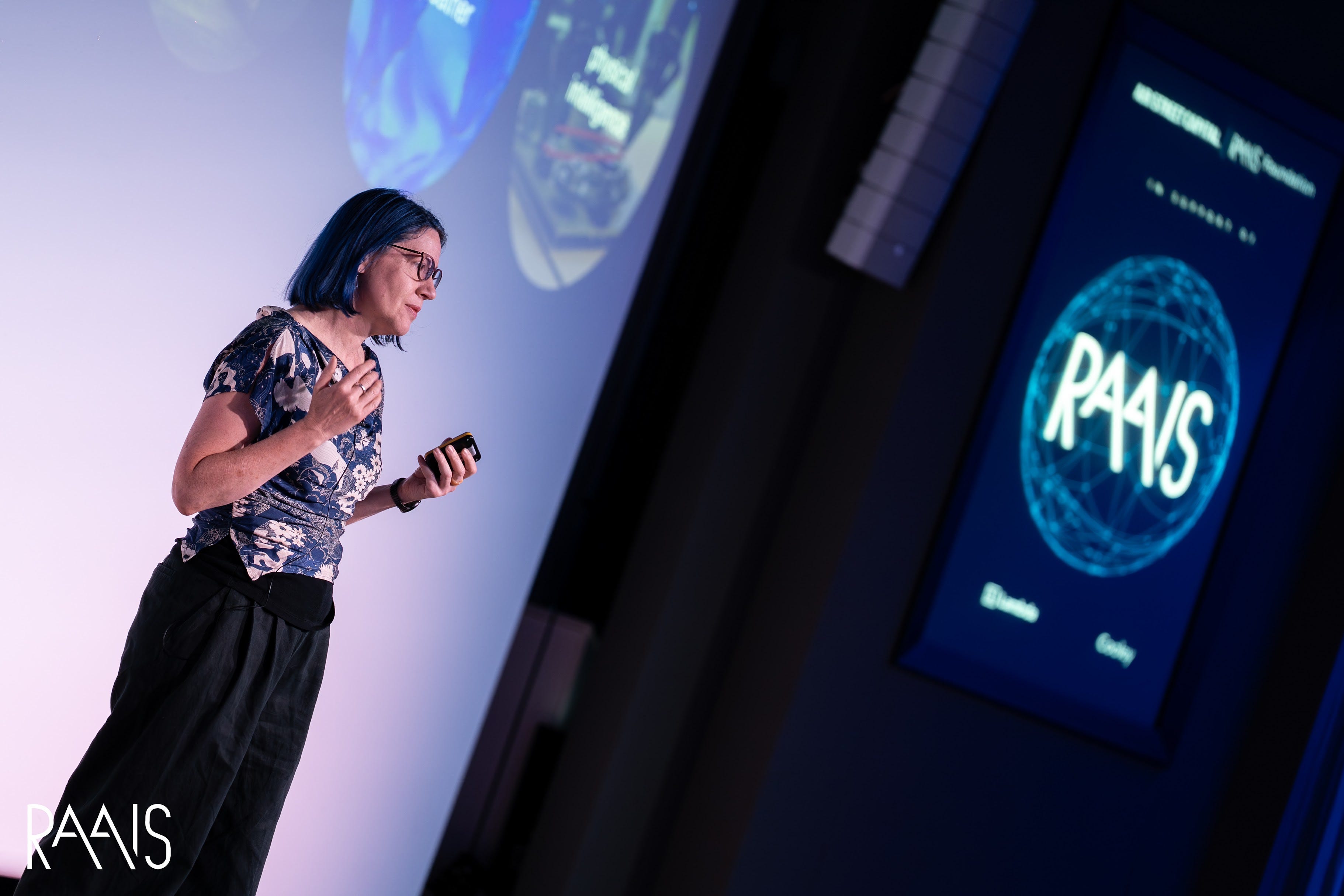
Hadsell has worked on robots for more than a decade and is blunt that the field is hard, an interplay of hardware, software, and understanding, with the goal of general-purpose machines that can drop into any task a human can do. DeepMind splits the problem the way a body does, into a brain and a spine. The spine handles the fast, fine motor control that should not have to route through the brain; the brain handles understanding and planning. Two models carry this. Gemini Robotics-ER 1.6 is a Gemini model tuned for spatial understanding and tool use, able to pick individual objects out of cluttered scenes. A separate vision-language-action model takes the visual input and the reasoner’s instructions and outputs motor control. Working with Boston Dynamics, they found tasks that needed more than spatial sense: getting Spot to read a small gauge required tool calls to magnify the dial and reasoning to interpret it.
The frontier, she said, is efficient learning. The ways to collect robot data run from expensive, narrow teleoperation, through physics simulators like MuJoCo, to the prize of learning directly from internet video. World models now sit in that chain. They can generate novel interaction data at high enough fidelity to train the robot model, and Hadsell said you cannot tell the real robot logs from the simulated ones. Pool that with cross-embodiment learning, where data collected on one robot transfers to others, and the performance gain comes “for free.” This is where the talk’s argument closes on itself: the same foundation-model recipe, pointed at worlds, becomes the engine that trains the robots.
Stop staring at language
Her closing note returned to the frustration she opened with: almost all the field’s attention sits on language, and she thinks that is a waste. The same recipe that produced today’s language models can be pointed at far richer systems: worlds, robots, biology, weather, and the diversity of Earth’s biosphere at planetary scale. The data already exists; the models have barely been built. The next decade of progress, on her account, runs through those systems, and has little to do with making chatbots bigger.