



José Penadés had spent the better part of a decade working out how one family of bacteria smuggles genes across species, the kind of horizontal gene transfer that helps antibiotic resistance spread. He had the answer, sitting on unpublished data, and he handed the same research goal to an AI system to see what it would do. Two days later it came back with his unpublished conclusion as its top hypothesis, plus four more, one of which his lab had never considered and is now working on. His first move was to email Google asking whether they had somehow got access to his computer.
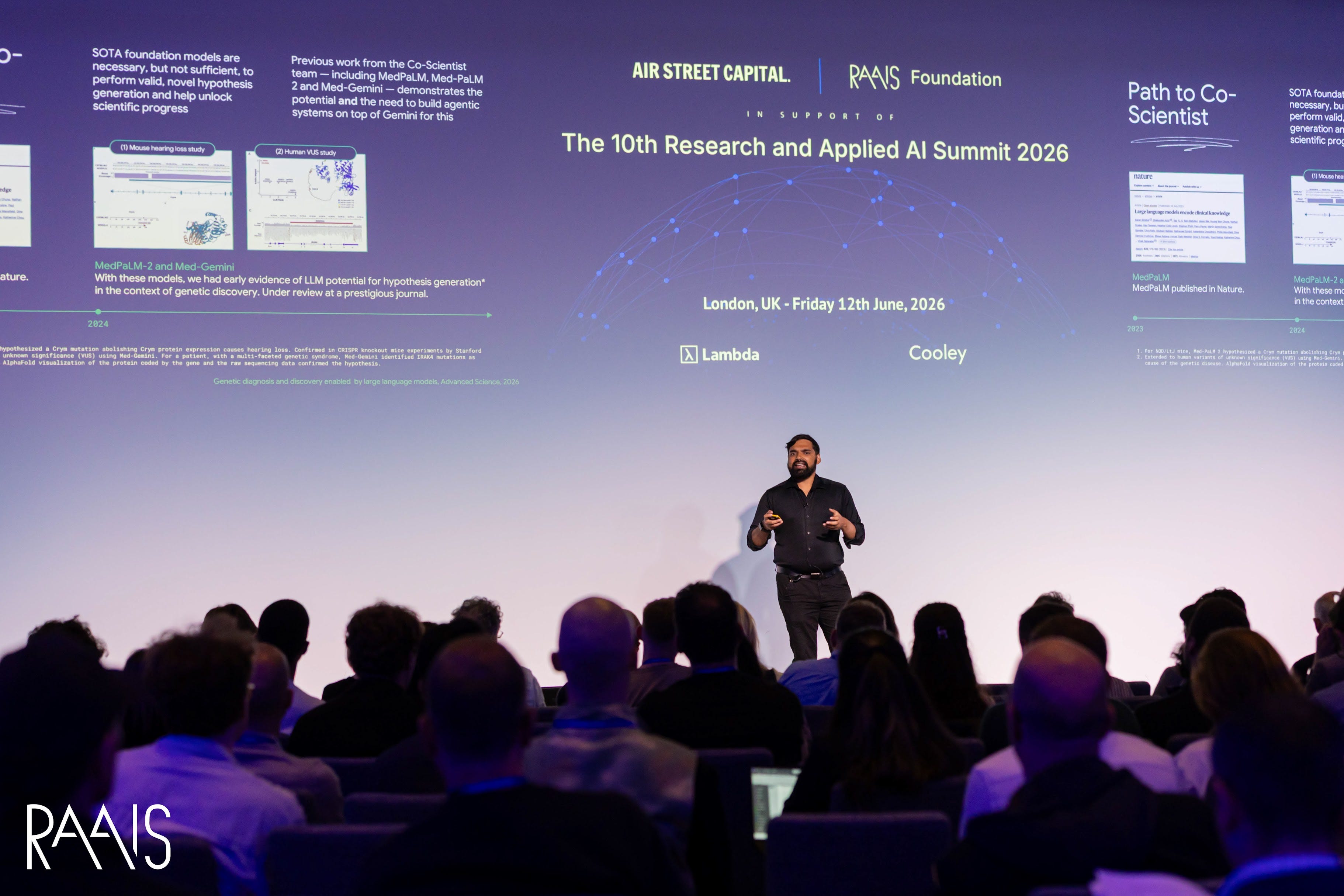
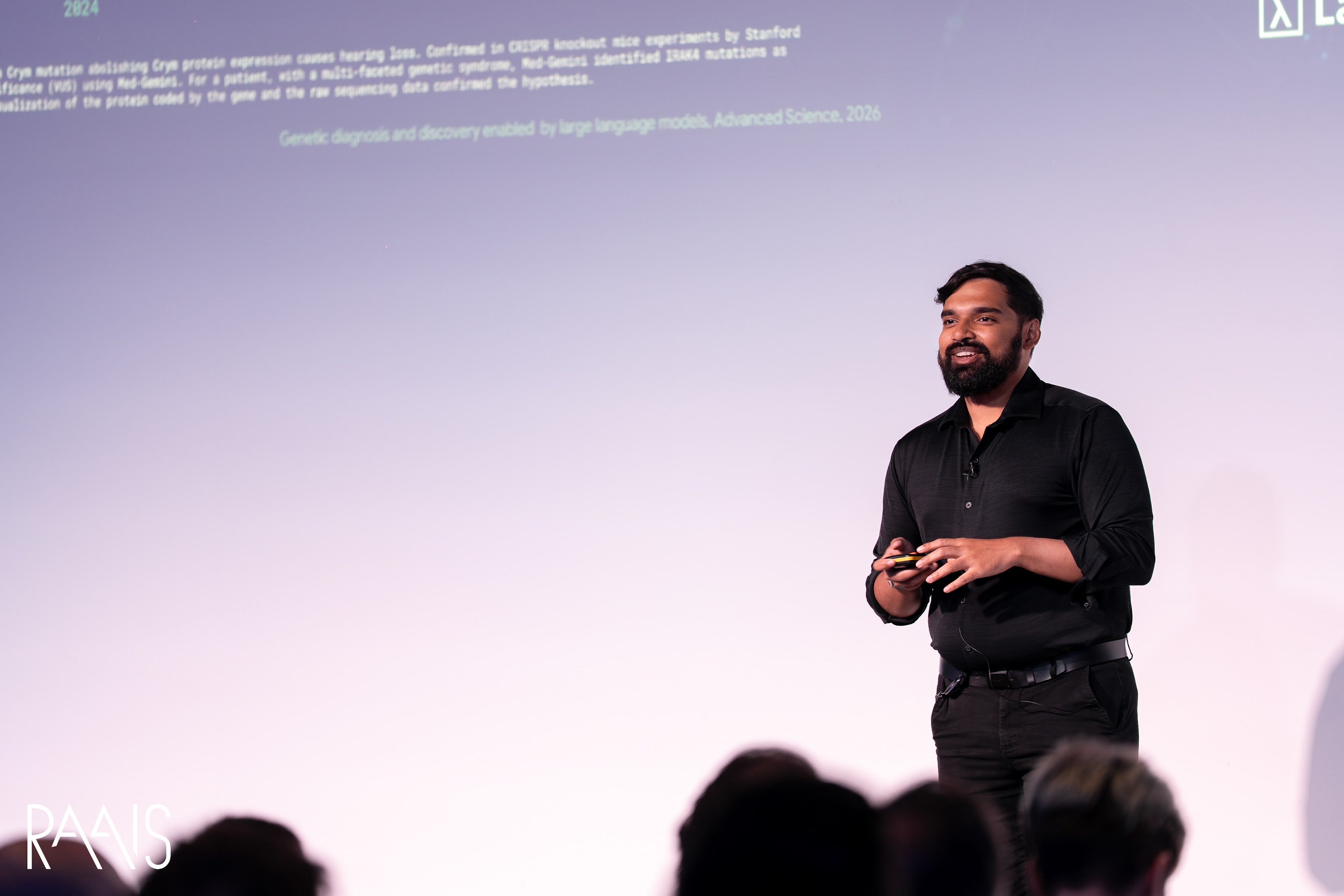
That story, which Vivek Natarajan told from the RAAIS stage, is the kind of result his team at Google DeepMind has been chasing. Natarajan is a Research Lead there, working at the intersection of AI, science and medicine. When he last spoke at RAAIS a couple of years ago, the state of the art was Med-PaLM, a language model tuned to answer medical exam questions. His pitch this year was more ambitious: that the recipe behind AlphaGo can be turned on science and the clinic, and that the trick is teaching models to stop thinking fast and start thinking slowly.
System one is not enough
The problem with using a chatbot as a scientist, Natarajan argued, is that even reasoning models mostly do “system one style thinking,” quick responses drawn from surface-level pattern matching. Real discovery is the opposite: slow, deliberate, rigorous, the product of chewing on a problem for weeks until the spark comes. He wanted “system two style thinking,” and to get it he reached back into DeepMind’s own history. AlphaGo’s 2016 breakthrough came from self-play and search, with agents playing each other, taking feedback from the environment, and reinforcing what won. AlphaZero then showed the same recipe could scale from zero knowledge to superhuman play in months, limited mainly by compute.
The AI co-scientist generalizes that idea. Instead of agents playing a game, they generate scientific hypotheses, then critique, debate and refine them over hours and days, what Natarajan calls a “generate, debate and evolve ideas loop.” Borrowing from AlphaStar, DeepMind’s StarCraft system, the team added tournaments: a ranking agent stages pairwise debates between hypotheses, scores them against a rubric derived from the scientist’s stated goal, and assigns Elo ratings, so only the strongest ideas reach the human. Because the debates run in natural language, they can be summarized and fed back into the agents’ context, which is what makes the system self-improving. It also lets the system signal its own uncertainty, what he called “epistemic humility,” which matters when the scarce resource you are spending is a scientist’s time.
The whole project nearly didn’t happen. The idea came from Gary Peltz, a Stanford geneticist who, after one of Natarajan’s lectures, suggested that a model trained on scientific text might generate hypotheses for the causes of rare disease. Most of the team thought it was too early. They did it anyway. Sometimes, as Natarajan put it, you “jump off the cliff, and then you figure out how to build an airplane on the way down.”
From hypothesis to organoid
The Penadés result, run with collaborators at Imperial College on antimicrobial resistance, was the moment the team realized they were onto something. But the more telling cases are the ones that ended in a wet lab. Physician-scientists at Houston Methodist used the co-scientist to find drug-repurposing candidates and combination therapies for acute myeloid leukemia. Peltz’s own lab pointed it at liver fibrosis, a disease with few treatments, and tested its picks in human liver organoids. One candidate, vorinostat, not only showed anti-fibrotic activity but cut TGF-beta-induced chromatin damage by over 91%, a hint of regeneration. The interesting part is that vorinostat is an FDA-approved cancer drug, exactly the kind of cross-field connection a liver specialist might never make, and the system surfaced it because it could read broadly while the human judged what mattered. Natarajan called this complementary intelligence, and it is the honest version of the pitch: the machine goes wide, the scientist goes deep.
He kept the limits in view. The system itself is general-purpose, he stressed, with nothing in the scaffolding specific to biology; the specialization comes from the tools it reaches for at runtime. But asked where it fails, he was candid that the wins so far have been in biology, where a mass of unread literature hides real signal. Chemistry is harder, and fields like mathematics and physics, which reward narrow depth-first reasoning over wide reading, harder still. The common thread is not biology or medicine specifically, but a way of turning compute into disciplined deliberation, then putting the result back in front of expert humans.
Manufacturing medical experience
The other half of the talk was about access. World-class medicine, Natarajan said, is “pretty much a geographic and socioeconomic lottery,” and his team’s second mission is to close that gap. The vehicle is AMIE, a diagnostic dialogue system he co-leads with Alan Karthikesalingam, a vascular surgeon still practicing in the NHS. Asked once how to choose between two doctors, Karthikesalingam told him to “always go with the one who has more gray hair.” There is no substitute for experience, so the team manufactured it. Using the same self-play machinery, AMIE ran consultations against synthetic patients and a critic, refining itself over millions of simulated dialogues. A human doctor might see 10,000 to 50,000 patients in a career; AMIE has already run hundreds of millions of conversations, “building up the world’s most experienced doctor,” with the heavy caveat that it all happens in simulation.
It is starting to pay off. In evaluations published in Nature, AMIE matched or beat physicians in simulated consultations with patient actors, on diagnosis and, more pointedly, on rapport, empathy and relationship building. “I’m kind of sorry about the doctors and humans in your life,” Natarajan deadpanned to the unsurprised. But this is not about replacement, he insisted: “the story is still about augmentation.” A companion study found that general physicians given complex diagnostic puzzles did significantly better with the AI as a thinking partner than working alone or with standard tools like web search. And in an early, supervised feasibility study with Beth Israel Deaconess in Boston, where patients spoke to the AI before an urgent-care visit under physician oversight, zero safety stops were required under the study’s predefined criteria, patient trust in AI rose after the interaction, and the system’s pre-visit diagnoses held up against the attending physicians, all without the benefit of lab tests.
A third person in the room
For most of modern medicine, Natarajan closed, the core unit of care has been a dyad: the doctor and the patient. His bet is that it is becoming a triad, the doctor, the patient and the AI, with the machine as a teammate rather than a tool. That is the idea behind the team’s next effort, an AI co-clinician. It is a tidy frame, and the evidence on stage made it land harder than it would have a year ago. The deeper claim running under both halves of the talk is that the self-play recipe which once mastered a board game can now give scientists and clinicians a new kind of thinking partner: one that searches widely, argues with itself, and hands humans better starting points. The wet labs and the early clinical studies are starting to agree.