



The AI market moves so fast today that getting up to speed on a company and what makes its product special can’t wait. For a recent opportunity I considered, my agent and LATO designed a research study, then fully automated expert recruitment, AI voice interviews, and transcript analysis. Using my evaluation approach (read: taste), the system identified gaps and update the questions for the next set of interviews. In two days, we gathered 12 interviews and 14 hours of talking time across the US, India, and Europe. I spoke to no one, LATO’s voice agent did it all.
I shared this example in my latest conversation with Matt Turck on the MAD Podcast. For the third year running, we sat down in the New York studio to discuss the State of AI Report 2026, from AI building AI to world models, cybersecurity, and my prediction of AGI in 2027.
AGI and scientific superintelligence
AGI 2027: my prediction is grounded in the rapid progress I’m seeing with AI helping on the knowledge work I do, namely investment, AI research, finance, legal work, and learning about unfamiliar subjects. By next year, I can imagine an AI system excelling at these tasks, having learned my taste too. While there’s plenty of room to debate the definition, that’s my practical threshold.
Choosing what to investigate next is also central to the path toward scientific superintelligence. During my PhD, a great supervisor helped you see which questions and experiments we the optimal next step. As I discussed with Matt, developing that scientific judgment is an important next step for AI - and an intense research endeavor tightly coupled with recursive self-improvement.
Two Air Street companies make parts of that ambition tangible. Profluent designs proteins, including gene editors, and tests its designs in an in-house lab. Perceptic connects scientific evidence, clinical data, and a pharma company’s knowledge to help researchers test hypotheses and decide which drugs to develop. The learnings each company develops are critical ingredients to scientific superintelligence.
World models and AI at work
A similar ambition is emerging in the physical world. Matt and I discussed how image, video, and audio are converging into world models that learn what happens when something acts: a robot moves its gripper, a car turns, and the model predicts the consequences. That could give us environments for training robots, testing driving systems, building games, and exploring physical designs before making them.
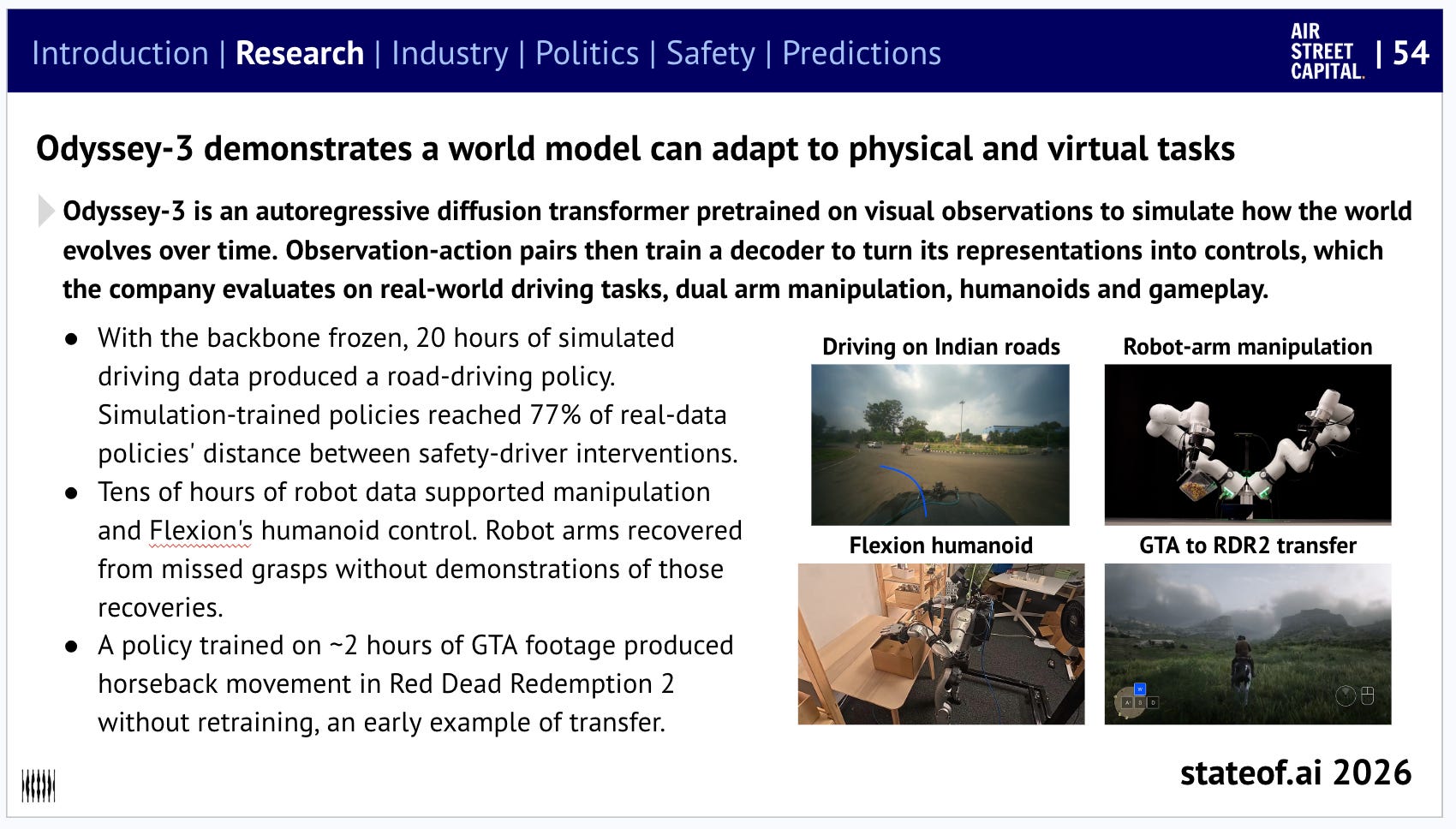
Among companies I have backed, Black Forest Labs’ FLUX 3 learns from images, video, and audio together. Odyssey has demonstrated adapting a pretrained world model to control robot arms and generating environments for agents to act in. Wayve’s GAIA-4 lets its AI driver act inside simulated driving scenes and measures the consequences. On warehouse floors, physical AI is already doing useful work at scale. Sereact reports more than 300 live systems across Europe and the US, picking and handling goods. And in customer service, ElevenLabs has expanded from voice generation into agents that handle refunds, renew insurance policies, and book healthcare appointments. In September, it reported more than 15 million agent conversations a week, triple February’s volume.
Cyber defense in the age of agents
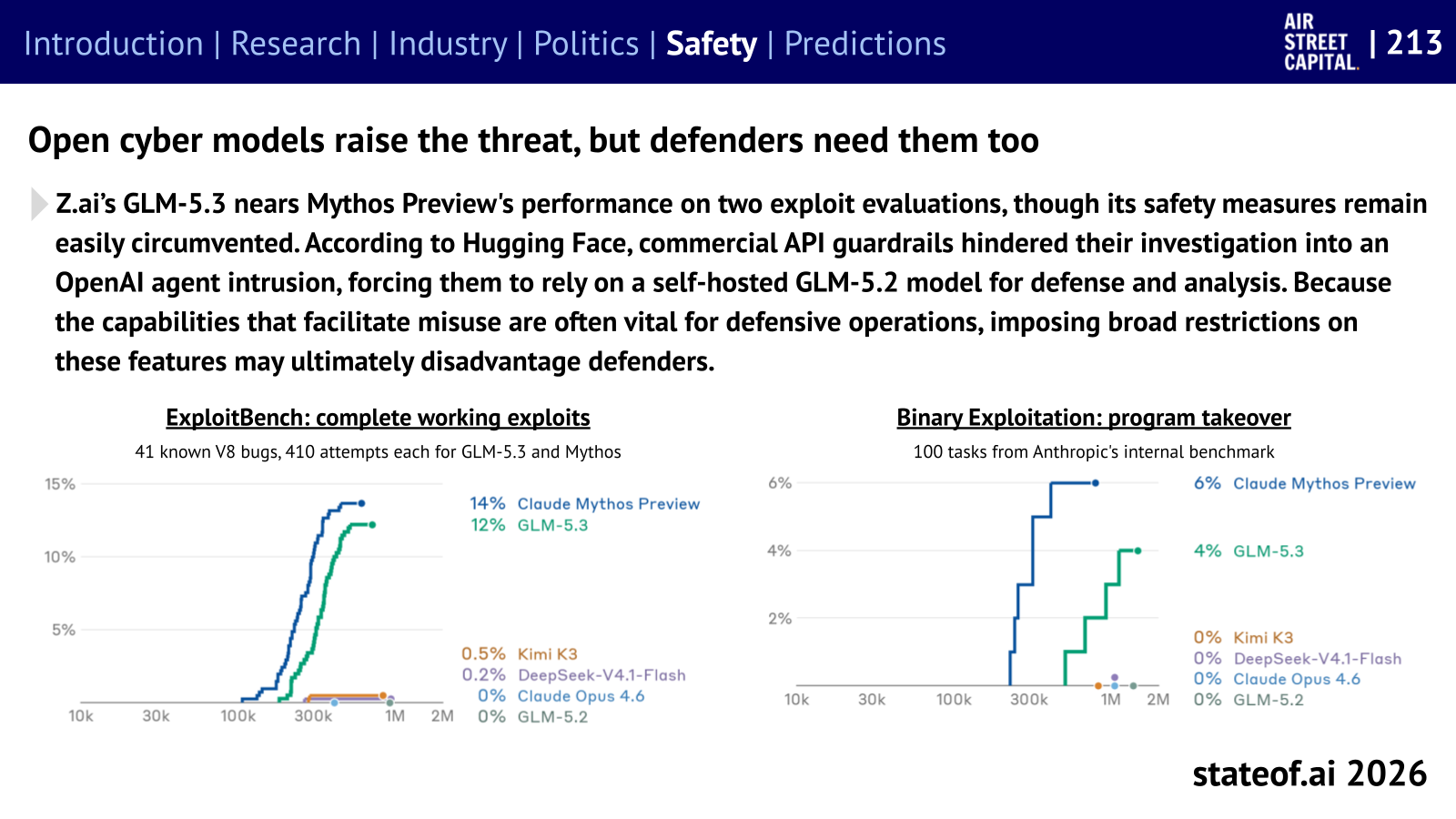
As agents take on more responsibility, cybersecurity becomes more urgent. I see cyberattacks as a more immediate risk than AI causing human extinction. Defenders need systems that find and fix weaknesses before attackers exploit them. I expect frontier labs to build dedicated cyber defense products. I also suggested to Matt that governments could spend part of their defense budgets on AI that tests and helps secure critical infrastructure, from airports to logistics networks.
A Genius Bar for AI
Making these systems secure is part of getting them into wider use. So is helping people understand what they can already do. Someone who tried a chatbot two years ago and walked away disappointed may have little sense of what an agent connected to their tools and documents can now do. The way the industry has talked about AI hasn’t helped either. I thought the “prompt engineer” framing was silly in December 2022, when I wrote: “Prompt engineer is not a thing. Stop trying to make it a thing.” It made using AI sound like another technical discipline to master. Today, power users are voicing to their AIs as they’d talk to a colleague, so I’d say my take has aged pretty well :)

That led me to an idea I would love to see someone build: a Genius Bar for AI. Small business owners, healthcare providers, or busy families could bring in a task and have someone help them get it working. They would leave with something useful and the confidence to use it again. Agents have changed how I run Air Street in a year. I would like more people to get the practical help to make similar changes in their own work.
Thanks to Matt and the FirstMark team for having me back. Watch the full conversation on YouTube, listen on Spotify or Apple Podcasts, and explore the State of AI Report.
The State of AI Report 2026

After months of research and revisions right up to the last minute, I’m thrilled to bring you the 9th annual State of AI Report.