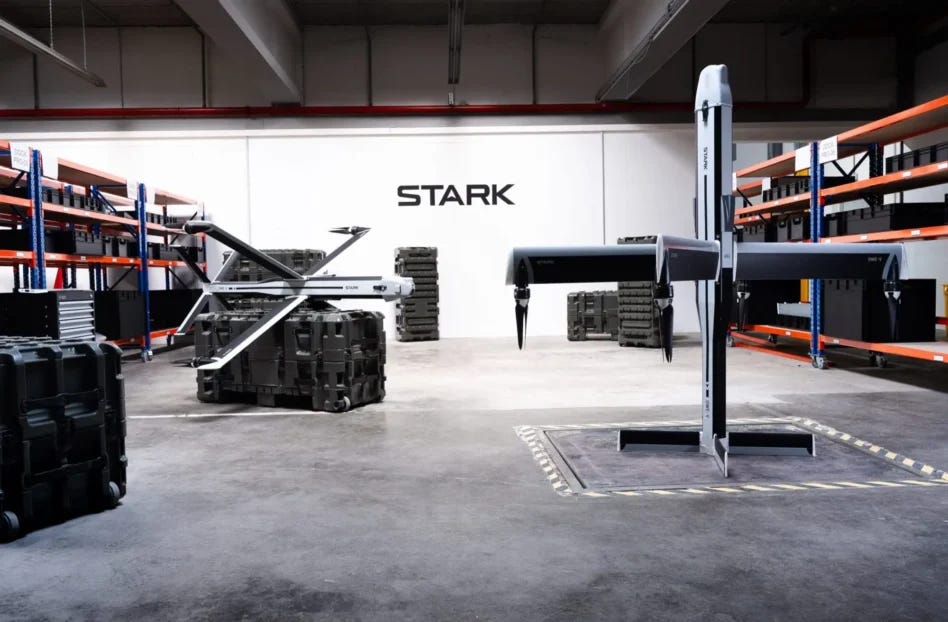
A modern main battle tank costs several million dollars. The drone that destroys it can cost a few thousand and be assembled in about ten minutes. That exchange, cheap machines destroying expensive ones in volume, is the most consequential lesson of the war in Ukraine, and it is now moving from the air to the sea.
This week STARK, the German defense company building exactly these systems, raised €500 million led by Sequoia and Founders Fund. I first met STARK’s CEO and Founder, Uwe Horstmann, back at Project A in 2016, years before any of this. Air Street Capital invested because we believe STARK is emerging as a German neoprime: a new prime contractor for unmanned strike systems, built software-first and able to manufacture at the scale a real war demands.

STARK builds autonomous platforms, fast
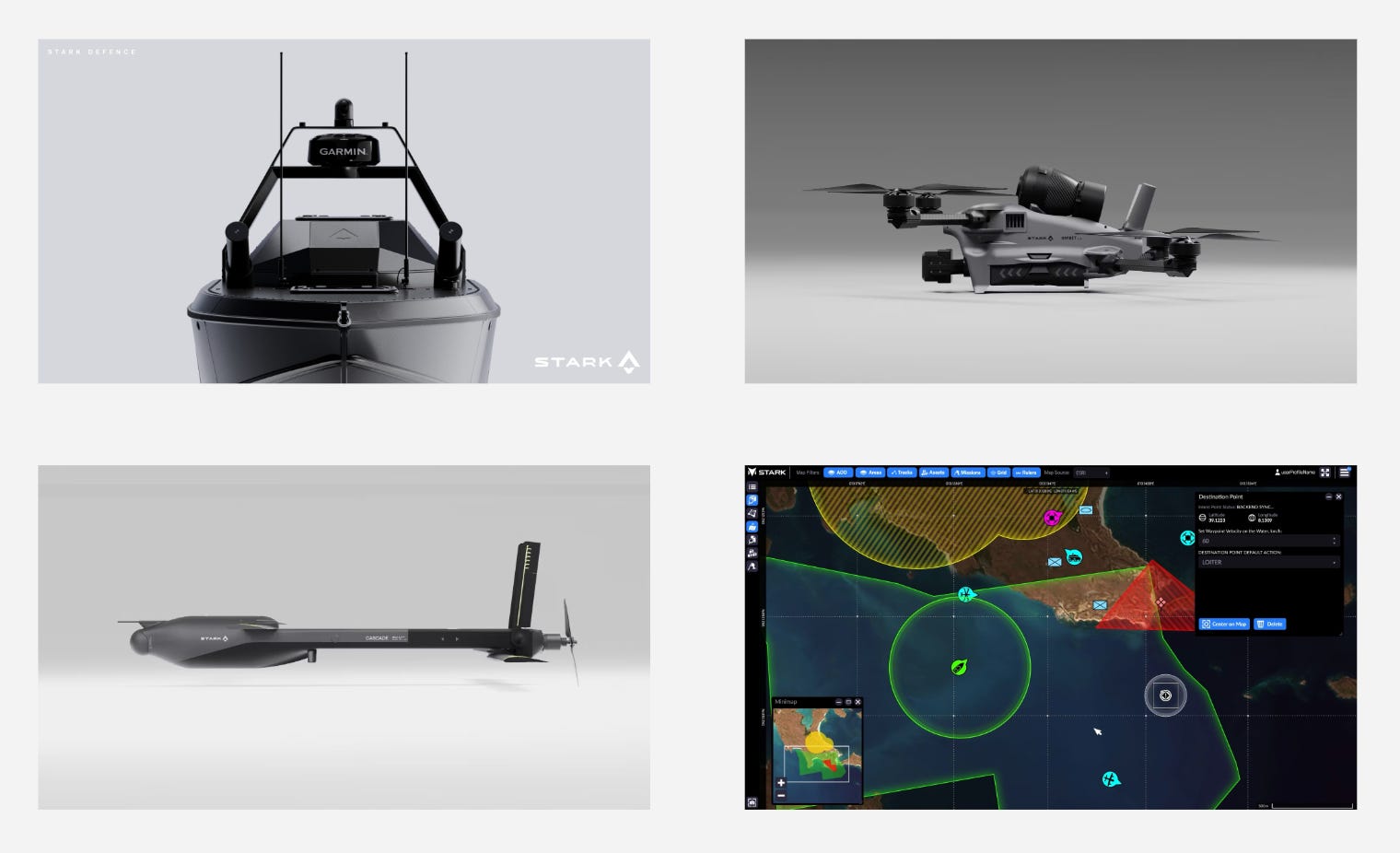
STARK’s flagship platform, Virtus, is a loitering munition: a drone that flies to a contested area, waits, finds a target, and strikes it. It is not a reconnaissance drone, though it can return and land like one, and it is not a cruise missile. It sits between the two, cheap enough to expend, autonomous enough to find a target on its own, and simple enough to build at scale. Around it STARK is building a family of effectors - Gambit, a man-portable short-range munition, and Cascade, a tube-launched one - alongside Vanta, an unmanned surface vessel that takes the same idea to sea.
Mass you can afford to build
For decades, Western firepower meant a small number of exquisite platforms, each costing millions and far too precious to lose. Ukraine inverted that. The decisive weapon turned out to be the cheap one you can field by the thousand and expend without flinching. A Virtus assembles in roughly ten minutes, and Germany has already put STARK on a framework worth up to €2.8 billion to supply the Bundeswehr, a landmark deal for a new defense company.
Once the weapon is cheap, the constraint moves to manufacturing and a robust supply chain. More than 80% of this round goes into manufacturing and R&D, and STARK is standing up production lines across Germany, the UK, and Ukraine. In a war of attrition, throughput is the moat: the side that can keep replacing what it loses sets the tempo. STARK builds on civilian supply chains and simple lines that stand up in weeks and replicate from city to city, which is both a way to scale and a way to survive being targeted. The defense companies that win this decade will treat the production line as the product.
Lastly, with a growing portfolio of autonomous products, STARK needs software to tie them all together: Minerva. The same software that swarms Virtus in the air coordinates the unmanned boats at sea, navigates when GPS is jammed, and plugs into NATO battle-management. Each platform improves with a software update rather than a new airframe, and every deployment teaches the whole fleet.
Why STARK
Uwe spent a decade as a general partner at Project A, one of Europe’s most active defense investors and an early backer of Quantum Systems, before leaving to run STARK. He has assembled the four branches this company needs at once. To build at scale: Martin Rost, sixteen years at Zalando running a roughly €10 billion unit, and Johannes Schaback, a repeat founder who was CTO of SumUp. To sell into defense: Jan-Patrick Helmsen, former CEO of Rheinmetall's weapons-and-munitions business. To win the politics: Johannes Arlt, until this year a member of the Bundestag's defense committee. And to learn from the war as it is fought: a Ukraine team running an R&D and production hub in Kyiv that turns frontline feedback into design changes.
Regular readers will be familiar with our defense thesis at Air Street Capital. We recently led the Series A for Alta Ares because Europe has to build its own air defense shield. In our letter from this year’s Munich Security Conference, we argued that Europe must move from emergency buying to structural production capacity, and that when a government contracts a domestic firm it confers the industrial gravity that pulls in private capital and localizes supply chains. STARK is what answering that call looks like: sovereign manufacturing, software-defined systems, and a founder building for the war that is actually being fought. The mass that wins the next conflict will be cheap, built at home, and improved in software, and we’re here to stand behind the people making it happen.