Introduction
In 2025, AI entered large-scale commercial deployment. Reasoning models made inference-time compute a new scaling axis, AI coding agents pulled automated software engineering into the present, and embodied AI alongside AI-accelerated scientific discovery emerged as major new battlegrounds. China’s open-weight ecosystem rapidly closed performance gaps with Western frontier models, even as the largest labs continued to widen their lead on capability-per-dollar. Scale remained the dominant force.
The economics followed. AI labs and public AI infrastructure companies added more net new revenue than the entire public SaaS sector. NVIDIA pushed beyond $4 trillion in market capitalization and catalyzed outsized returns across the AI semiconductor supply chain. Multi-gigawatt compute clusters moved from announcements to physical sites constrained by power availability, grid access, and geopolitics. AI infrastructure became industrial policy, with sovereign capital, export controls, and national champions shaping who can train, deploy, and profit from frontier systems. The US, in particular, moved forcefully to treat AI as a key competitive vector.
It is still early innings. Capabilities that would have seemed like magic a decade ago are now real and usable, and the opportunity ahead lies in deploying them widely and embedding them into the systems that matter. The next phase will be determined by who can convert frontier capability into durable, widespread use across economically meaningful tasks under real-world constraints of energy, economics, and politics.
In our 2025 year in review, we cover Air Street Capital, Air Street Press, the State of AI Report, and our community engagement.
Portfolio updates: AI investments across defense, healthcare, robotics, and fintech
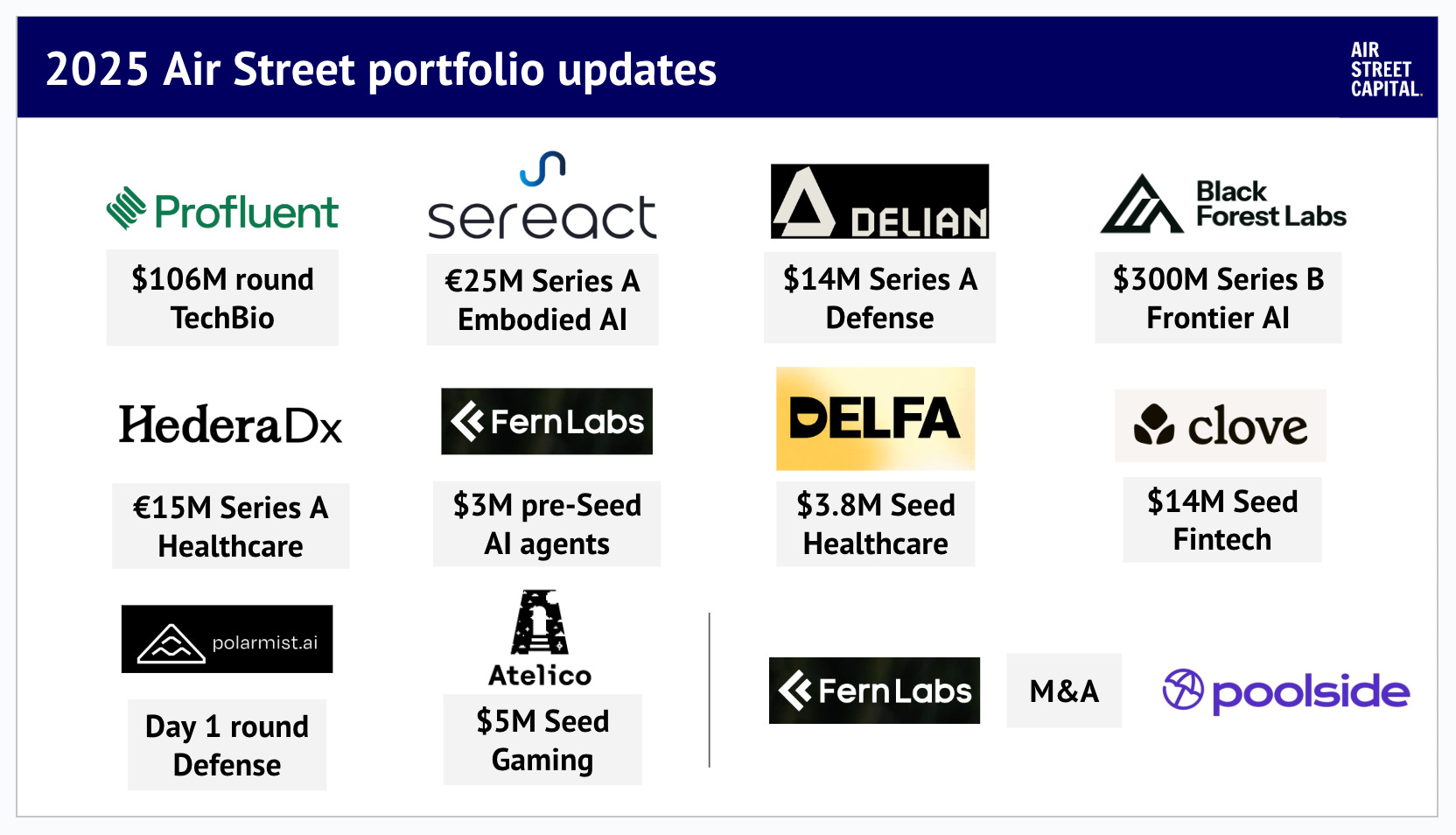
In 2025, we made eight new investments across gaming, defense, healthcare, frontier AI and fintech, including Studio Atelico, Polar Mist, Delfa, Clove, and four companies yet to be announced. We also made two follow-on investments in techbio and defense, Profluent and Delian Alliance Industries, bringing Fund II to 18 active portfolio companies. During the year, we exited Fern Labs, a long-horizon agent company, to frontier AI company, poolside, via M&A.
Now turning to the portfolio highlights:
New investments:
Fern Labs: $3M Seed (solo investor). Fern Labs is the platform where networks of agents can create, test and iteratively improve software artifacts over long time horizons. The founding team previously built agent-driven AI systems at Palantir.
Polar Mist: Day 1 financing (co-lead investor). Polar Mist is building maritime autonomy for European defense. The company builds full-stack unmanned maritime defense, combining on-board jamming-free navigation with robust hardware platforms for long-range autonomous reconnaissance, logistics, and strike missions.
Delfa: $3.8M Seed (lead investor). Delfa is the AI-first operating system for clinical trials, starting with participant enrollment, where delays and cost are still driven by spreadsheets, phone calls, and duplicated site-by-site processes. Delfa’s agents are already deployed across 50+ live clinical trials trials.
Studio Atelico: $5M Seed (lead investor). Studio Atelico is an AI-first games studio. The founding team combines frontier ML and on-device optimization experience with award-winning game design, spanning Uber AI Labs, Meta, and Creative Assembly’s Total War franchise.
Clove: $14M Seed (co-investor). Clove is building an AI-native wealth management institution. The platform will pair regulated human advisors with an AI-first operating environment that absorbs repetitive and compliance-heavy work so advisors can serve more clients with consistent, transparent delivery.
Black Forest Labs: $300M Series B (co-investor). Black Forest Labs, founded by key inventors behind latent diffusion and Stable Diffusion, is translating research leadership into a category-defining visual intelligence company. The company has rapidly won Fortune 500 adoption and deep enterprise integrations as well as more than 400 million downloads of its open-source category-leading FLUX models.
Follow-on investments:
Sereact: €25M Series A (follow-on). Sereact is the frontier robotics research and deployment company, starting with warehouse automation. The platform supports picking and packing, quality checks, sorting, and inventory workflows.
Hedera Dx: €15M Series A (follow-on). Hedera Dx is scaling decentralized, hospital-run liquid biopsy testing using circulating tumor DNA, shifting advanced cancer diagnostics from a small number of centralized reference labs into routine clinical care across hospital networks.
Delian Alliance Industries: $14M Series A (co-lead investor). Delian builds vertically integrated, AI-first defense systems that autonomously sense and strike across land, air, and sea. Its full-stack portfolio spans GPS-denied navigation, electronic warfare, and autonomous effectors, built in Europe to defend Europe and its allies.
Profluent: $106M financing (follow-on). Profluent is a frontier AI company focused on writing biology. They’re scaling protein language models trained on the world’s largest private corpus of natural proteins (the Profluent Protein Atlas). The company has released the open source OpenCRISPR-1 AI-designed gene editor and entered into a handful of commercial deals spanning drug discovery and agriculture.
Exits:
Poolside (Fund I) acquired Fern Labs (Fund II) to deepen its push into long-running, reliable enterprise agents, bringing together agentic infrastructure and frontier models under one roof. Performance, reliability, and developer ergonomics are converging into a single stack that the winning frontier labs will own end-to-end. This deal was a special one for Air Street Capital, as we’re first investors in both poolside and Fern Labs.
Angel and pre-Air Street portfolio: AI infrastructure, enterprise software, and space
Across my angel and pre-Air Street portfolio, 2025 was a year where many AI-first companies scaled in earnest:
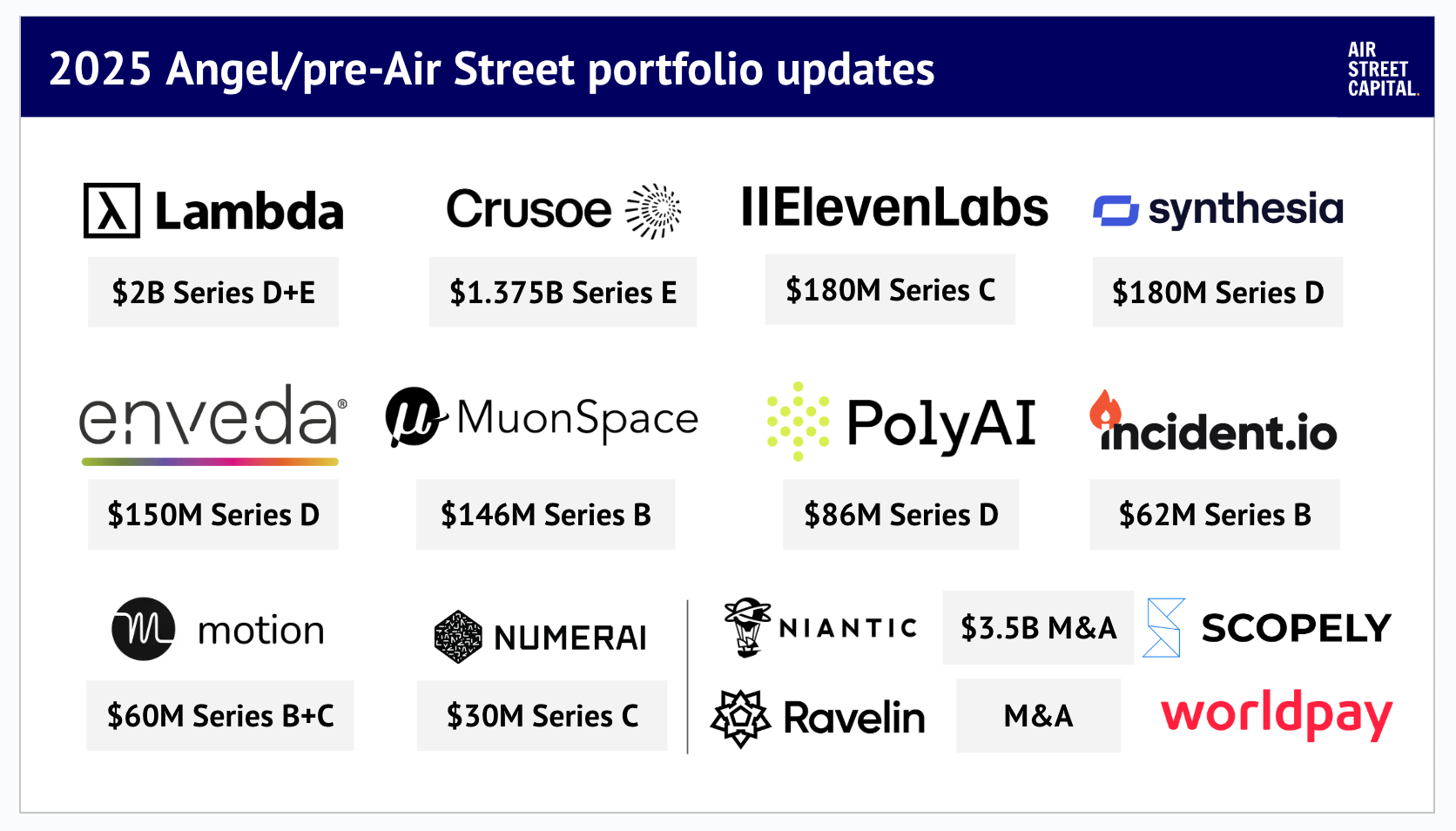
As the US pushed to rebuild domestic energy and AI capacity, Crusoe and Lambda both raised large rounds to meet demand for compute. Crusoe closed a $1.375B Series E at a $10B+ valuation to expand its vertically integrated AI factories, now underpinning OpenAI’s Stargate. Lambda raised a $480M Series D followed by a $1.5B+ Series E to deploy gigawatt-scale supercomputers for customers training and serving frontier models.
Elsewhere, Enveda raised a $150M Series D at a $1B valuation to advance its clinical pipeline built on AI-enabled natural compound discovery. Muon Space raised a $146M Series B to scale satellite manufacturing as demand grows for sovereign, vertically integrated space systems.
In enterprise software, Synthesia raised a $180M Series D as AI video became a default format for enterprise communication, now used by over 60% of the Fortune 100. ElevenLabs announced a $180M Series C as it closed in on $200M ARR for its AI-first audio products. PolyAI raised an $86M Series D as its voice agents handled tens of millions of high-stakes calls across healthcare, finance, and hospitality. incident.io raised a $62M Series B to build agents that actively resolve incidents with engineering teams. Motion raised $60M across Series B and C, scaling an agentic work platform used by over 10,000 businesses. Finally, Numerai raised a $30M Series C to continue running an AI-native hedge fund at scale.
Two companies were acquired in 2025: Niantic, creator of Pokémon GO, was acquired by Scopely for $3.5 billion, closing out one of the most successful stories in blending AI, games, and the physical world of all time. Ravelin, an AI-first fraud prevention platform for online commerce, was acquired by WorldPay.
Air Street Press
Air Street Press is the home for all of our analytical essays on AI research, industry playbooks as they take shape, policy memos, monthly State of AI newsletters, the annual State of AI Report, and our global event series.
In the last year, Air Street Press has clocked over half a million views, up almost 50%. Our most popular work included:
State of AI Report 2025
In October, we released the eighth edition of the State of AI Report, the most widely read and trusted annual review of progress across AI research, industry, politics, and safety. The 2025 edition focused on the emergence of reasoning models, the economics of frontier systems, the resurgence of open-weight models, power as a binding constraint, and the acceleration of sovereign AI efforts among governments with the capital and political will to pursue them.

The report reached an even broader audience than in prior years and was a discussion springboard across leading AI labs, startups, governments, and investors. It was debated, critiqued, and pressure-tested in public and private, which is precisely its role.
To mark its release, we hosted State of AI launch events in San Francisco and New York, bringing together founders, researchers, and operators to discuss what the year’s progress actually implies for deployment, competition, and policy.
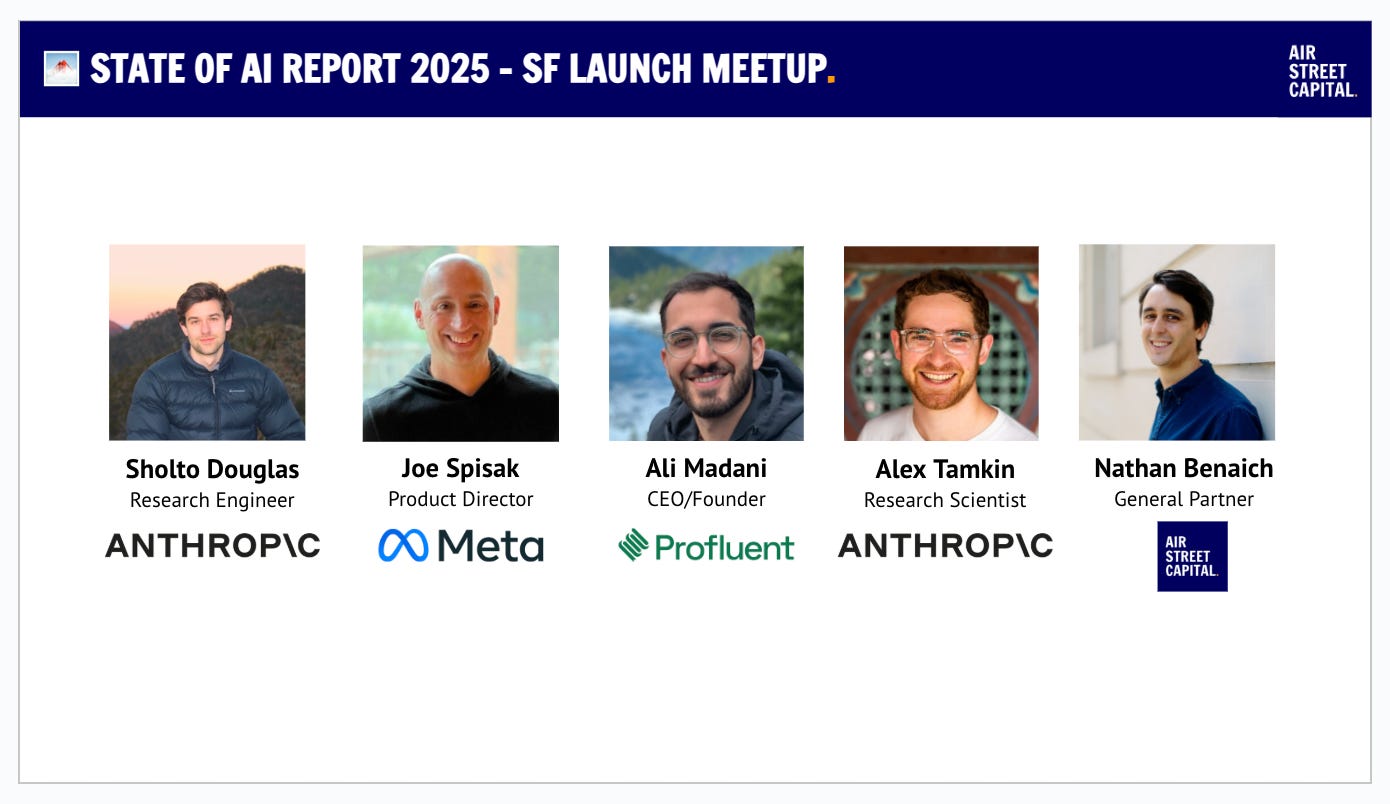
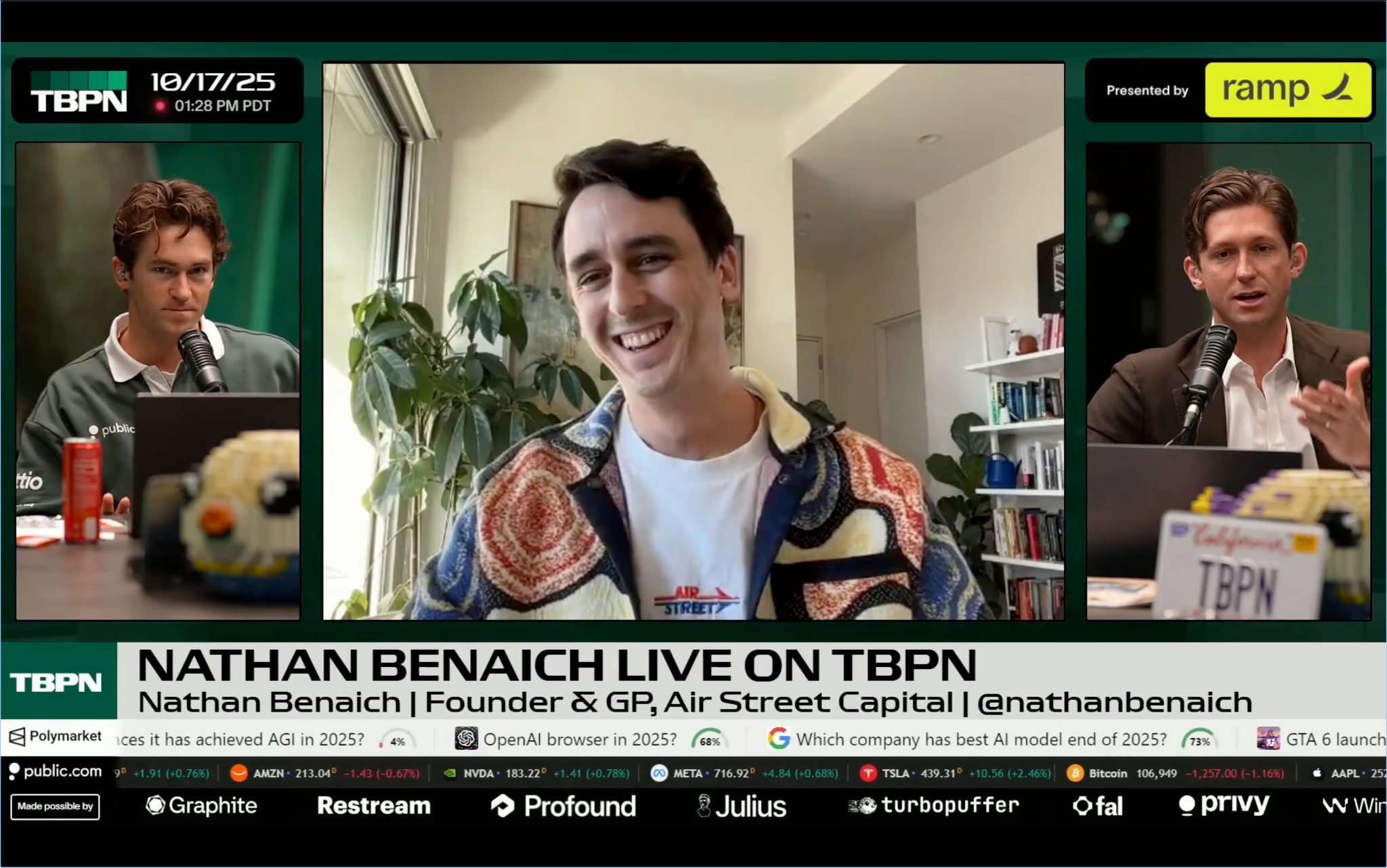
Those conversations continued across podcasts, panels, and closed-door sessions in the months that followed, informing how many in the field are thinking about what comes next. You can tune into podcasts I joined on TBPN, Matt Turck’s MAD podcast in New York, Turner Novak’s The Peel podcast, Daniel Bashir’s The Gradient podcast, and TechBio Talks with Chris Gibson (Recursion) in New York.
Community: AI researchers, founders, and operators
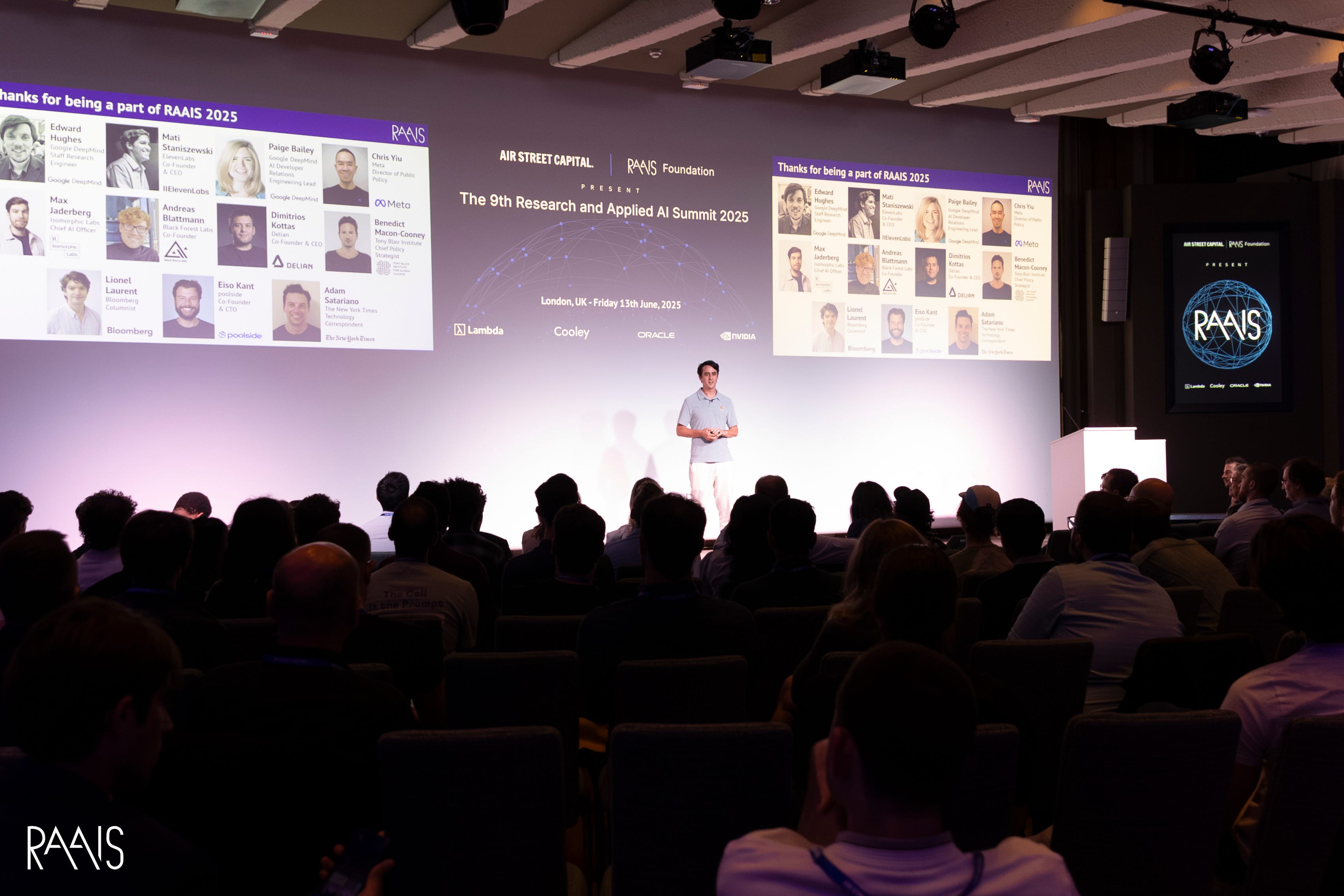
In 2025, we continued to spend time where we learn best: in rooms with people actually building and deploying AI systems. Through Air Street AI meetups and the ninth edition of the Research and Applied AI Summit (RAAIS), we brought together hundreds of researchers, founders, and operators to compare learnings on what is working, what is breaking, and what is changing faster than expected.
We keep RAAIS and Air Street AI meetups intentionally small and highly curated, with an emphasis on open discussion. Conversations in 2025 ranged from AI-first biology and coding agents to defense, open models, and the realities of scaling systems under real-world constraints. The goal is simple: help people learn faster from one another and leave with ideas they can apply immediately.
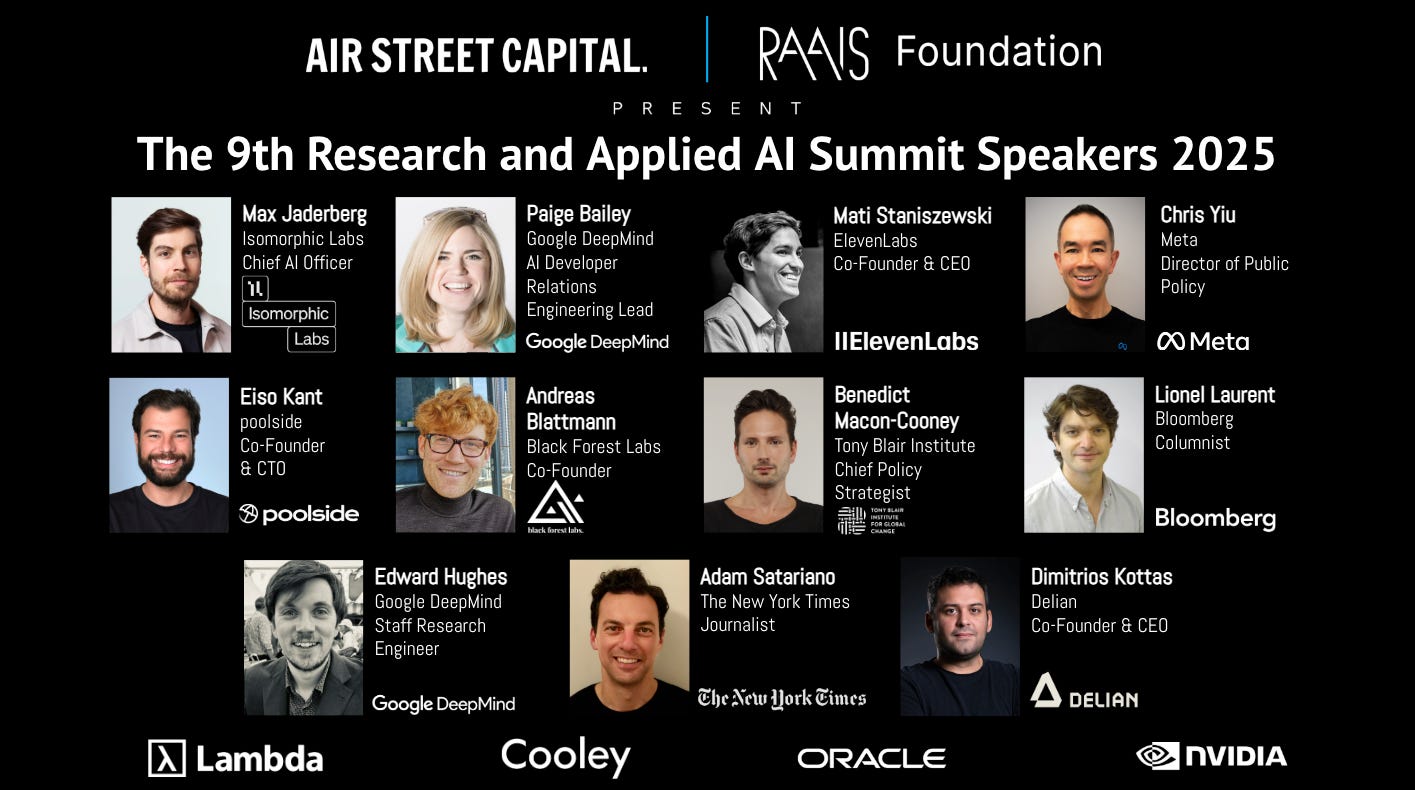
RAAIS remains a highlight of the year, which you can watch on our YouTube channel and read the takeaways on Air Street Press. All proceeds support the RAAIS Foundation, which funds open educational resources and works to broaden participation in advanced AI research. We’ll return on 12 June 2026 for the tenth edition and continue to host events across Europe and North America throughout the year. Join us in Munich (17 Feb), Zurich (19 Feb), Paris (11 March), San Francisco (29 April), and London (12 June).
Here’s to a big 2026!
If 2023 and 2024 were about discovering and pushing what AI could do, 2025 was about learning where it actually works in the real world at scale. The next chapter will be defined less by frontier breakthroughs and more by diffusion: who can make AI dependable, affordable, and embedded in the systems that matter. That is where we continue to focus, and where we are most excited to build. We can’t wait to see what the community achieves in the coming year!
As ever, drop me a reply on nathan@airstreet.com if you’re building in AI.